Introduction: Why the United Nations Still Matters
The United Nations (UN) is the world’s largest intergovernmental organization, established on 24 October 1945 to promote international peace, security, human rights, and cooperation among nations.
In today’s world, as global issues such as war, climate change, poverty, and health crises continue to escalate, the UN provides a common platform where nations can come together to find solutions.
In the 21st century, the world has become more interconnected than ever before. A problem facing a single country—such as a pandemic, terrorism, or climate change—can often evolve into a global issue. In this context, the United Nations serves as a forum that encourages dialogue, cooperation, and conflict resolution among nations.
Often regarded as the world’s largest international organization, the UN has made significant contributions in the fields of peacekeeping missions, humanitarian aid, and sustainable development. Consequently, its role remains vital for global stability and cooperation in the modern era.
The United Nations at a Glance
Before examining the achievements, challenges, and future prospects of the United Nations, it is important to understand its origins, objectives, structure, and key institutions. This overview provides a concise introduction to how the UN was established and how it functions today.
Origins and Founding of the United Nations
The United Nations was established after the Second World War, which is considered one of the most destructive conflicts in human history. Millions of lives were lost, numerous cities were devastated, and the entire world was plunged into economic and political instability.
Following the war, world leaders realized that without fostering cooperation and dialogue among nations, even greater conflicts could arise in the future. This realization led to the idea of creating an international organization that would provide a common platform for countries.
In 1945, representatives from 50 countries drafted the UN Charter during the San Francisco Conference. Following the ratification of the Charter, the United Nations was officially established on October 24, 1945, with the primary objective of promoting international peace, security, and cooperation.
Objectives and Core Principles of the United Nations
The United Nations was created not only to prevent future wars but also to build a framework for long-term global cooperation. Its objectives go beyond maintaining peace and include promoting development, protecting human rights, addressing humanitarian crises, and strengthening international partnerships. To achieve these goals, the organization follows certain core principles laid down in the UN Charter:
- All member states are considered equal regardless of their size or power.
- Countries should resolve disputes through peaceful means.
- Members should respect international law and UN obligations.
- Nations should cooperate to solve common global challenges.
- The use of force should be avoided except in accordance with the UN Charter.
Together, these objectives and principles provide the foundation for the United Nations’ role in global governance and international cooperation.
Organizational Structure and Membership
Today, the United Nations is a global organization comprising 193 member states, encompassing nearly every sovereign country. Its headquarters is located in New York, United States, while it also maintains major offices in Geneva, Vienna, and Nairobi. To manage its operations effectively, the UN functions through six principal organs:
- The General Assembly,
- The Security Council,
- The Economic and Social Council (ECOSOC),
- The International Court of Justice (ICJ),
- The Secretariat, and
- The Trusteeship Council.
While each of these organs has distinct responsibilities, they share a common objective: promoting international peace, security, and cooperation. The effective functioning of such a large international organization also depends on a professional bureaucracy, which helps in policy implementation, coordination, and administration across different UN agencies.
The Security Council is considered the UN’s most powerful organ, responsible for handling matters related to international peace and security. It consists of 15 members in total, including five permanent members (P5)—
- The United States,
- Russia,
- China,
- The United Kingdom, and
- France.
These permanent members hold veto power, allowing them to block any significant resolution, even if a majority of countries support it. The remaining 10 non-permanent members are elected for two-year terms. India has served as a non-permanent member of the Security Council on several occasions and has consistently advocated for permanent membership.
In the General Assembly, every member country holds a single vote, regardless of its size or economic strength. Additionally, the UN recognizes six official languages:
- Arabic,
- Chinese,
- English,
- French,
- Russian, and
- Spanish.
This organizational structure and membership system combine to make the UN one of the world’s most important international institutions.
Major UN Agencies and Programmes
| Agency / Programme | Full Form | Key Function |
|---|---|---|
| WHO | World Health Organization | Global public health, disease control, and health emergencies |
| UNICEF | United Nations Children’s Fund | Protection of children’s rights, education, nutrition, and welfare |
| UNESCO | United Nations Educational, Scientific and Cultural Organization | Promotion of education, science, culture, and heritage preservation |
| UNDP | United Nations Development Programme | Poverty reduction, sustainable development, and governance support |
| UNHCR | United Nations High Commissioner for Refugees | Protection and assistance for refugees and displaced persons |
| WFP | World Food Programme | Emergency food assistance and combating hunger worldwide |
| FAO | Food and Agriculture Organization | Food security, agriculture, and rural development |
| ILO | International Labour Organization | Labour rights, decent work, and social protection |
| UNEP | United Nations Environment Programme | Environmental protection and climate action |
| UN Women | United Nations Entity for Gender Equality and the Empowerment of Women | Gender equality and women’s empowerment |
Together, these specialized agencies enable the United Nations to address diverse global challenges, ranging from public health and education to food security, environmental protection, and humanitarian relief.
Major Achievements of the United Nations
- Maintaining International Peace – The UN has endeavored to reduce violence and establish stability by deploying peacekeeping missions in conflict-affected regions.
Example: UN Mission in South Sudan (UNMISS), where the UN provided protection and humanitarian assistance to hundreds of thousands of civilians during the civil war. - Protecting Human Rights – The UN has adopted numerous conventions and declarations to promote human rights on a global scale.
Example: Universal Declaration of Human Rights (UDHR), 1948, which recognized fundamental rights such as equality, freedom, and dignity globally and remains the foundation of human rights laws today. Along with governments, civil society organizations have also played an important role in promoting human rights, creating public awareness, and supporting vulnerable communities across the world. - Humanitarian Assistance – Provision of food, shelter, medical aid, and emergency relief during wars, natural disasters, and humanitarian crises.
Example: The World Food Programme (WFP) provided emergency food assistance to millions of people in crisis-affected regions such as Yemen, Sudan, and Gaza. - Global Health Initiatives – UN agencies have supported disease control, vaccination campaigns, and public health programs.
Example: Smallpox Eradication Programme, under which worldwide vaccination campaigns were conducted, leading the WHO to officially declare the eradication of smallpox from the world in 1980. - Sustainable Development – Seventeen Sustainable Development Goals (SDGs) were launched to promote poverty reduction, quality education, clean water, climate action, and economic growth.
Example: The 2030 Agenda for Sustainable Development, adopted by all UN member states. - Refugee Protection – Protection, shelter, and legal assistance have been provided to refugees and internally displaced persons.
Example: Syrian Refugee Crisis, where the UNHCR provided shelter, healthcare, and educational support to hundreds of thousands of refugees in neighboring countries. - International Cooperation – The UN has strengthened dialogue, diplomacy, and collective action among nations to find collaborative solutions to global challenges.
Example: Paris Climate Agreement (2015), adopted under the UN Framework Convention on Climate Change (UNFCCC), in which nearly all countries committed to limiting global warming.
Key Challenges Facing the United Nations
The United Nations has made significant contributions to global peace, security, and development. However, despite these achievements, the organization continues to face several political, financial, and institutional challenges. These issues often limit its ability to respond quickly and effectively to global crises. Some of the major challenges are discussed below:
- Veto Power in the Security Council – The five permanent members (P5) of the UN Security Council possess veto power. If even one of these countries disagrees with a resolution, it cannot be passed, regardless of whether the other countries support it. Consequently, taking timely action on many important global issues becomes difficult.
Example: During the Russia-Ukraine war, Russia used its veto power to block several Security Council resolutions.
- Demand for Security Council Reform – Many countries believe that the Security Council’s current structure does not properly represent today’s world, as it is based on the balance of power from 1945. Therefore, developing countries and emerging economies are demanding permanent membership.
Example: India, Japan, Germany, and Brazil (the G4 countries) have been demanding permanent seats on the Security Council for years.
- Difficulty in Resolving Global Conflicts – The UN’s primary objective is to maintain international peace, yet many conflicts persist. Due to political differences and the conflicting interests of powerful nations, the UN is unable to take effective action in every situation.
Example: In the Israel-Hamas conflict and the Syrian Civil War, the UN facilitated peace talks and provided humanitarian aid, but a permanent solution has not yet been found.
- Financial Constraints – The UN relies on financial contributions from member countries for its peacekeeping missions, humanitarian aid, and development programs. When countries fail to make their contributions on time, various programs and operations are affected.
Example: Due to funding shortages, some UN peacekeeping missions and humanitarian projects have faced budget cuts.
- Human Rights Violations – While the UN promotes human rights, it often cannot directly intervene in the internal affairs of member countries. This makes it challenging to prevent serious human rights violations.
Example: Following the 2021 military coup in Myanmar, the UN appealed for the restoration of democracy and the protection of civilians but was unable to control the situation fully.
- Lack of Enforcement Power – The UN does not possess the power to implement its resolutions or compel a country to act directly. Member states often disregard UN decisions, which diminishes the organization’s effectiveness.
Example: Despite the imposition of numerous UN sanctions on North Korea, its nuclear program could not be completely halted.
- Balancing National Interests and Global Cooperation – Every country prioritizes its national interests. Consequently, reaching a consensus on significant international issues often becomes difficult, slowing down the UN’s decision-making process.
Example: During climate change negotiations, disagreements have frequently arisen between developed and developing nations regarding climate finance and emission reduction targets.
The United Nations and Emerging Global Threats
When the United Nations was established in 1945, its primary focus was maintaining international peace and preventing wars. However, the nature of global challenges has changed significantly in the 21st century. Today, issues such as climate change, cybersecurity, AI, pandemics, food insecurity, and fake news have become major global concerns.
The impact of these challenges is not limited to a single country; rather, it affects the entire world. Consequently, solutions to these problems are possible only through international cooperation. The United Nations provides a common platform where countries collaborate on public policy, international agreements, and collective action to confront these emerging threats.
To better understand this challenge, let us look at an example—
Misinformation and Disinformation- In today’s digital era, the rapid growth of social media and Artificial Intelligence (AI) has led to a swift rise in the spread of fake news, deepfake videos, and misleading information. Such misinformation can influence public opinion, trigger social unrest, and erode public trust in democratic institutions. For this reason, the United Nations promotes media literacy, emphasizes the responsible use of AI, and encourages international cooperation among nations to mitigate the impact of misinformation.
Example: During Operation Sindoor (2025), numerous fake videos, edited images, and false claims regarding military operations went viral on social media. Pakistan-based social media accounts shared fabricated claims that exaggerated losses suffered by the Indian Armed Forces and circulated old or unrelated videos, falsely attributing them to Operation Sindoor. Subsequently, the PIB Fact Check Unit verified these viral claims and declared several posts to be fake or misleading. This incident illustrates how rapidly misinformation can spread across digital platforms and highlights the critical importance of relying solely on verified sources and fact-checked information during any conflict.
Future Prospects for the United Nations
The United Nations has been working for international peace and cooperation for almost 80 years. But its relevance in the future will depend not only on its past achievements, but on how modern and effective it has been able to make itself according to the changing global needs. If the organization implements timely reforms and has strong support from member countries, the UN will continue to be the most important platform for global governance in the coming decades.
India’s Role in the United Nations
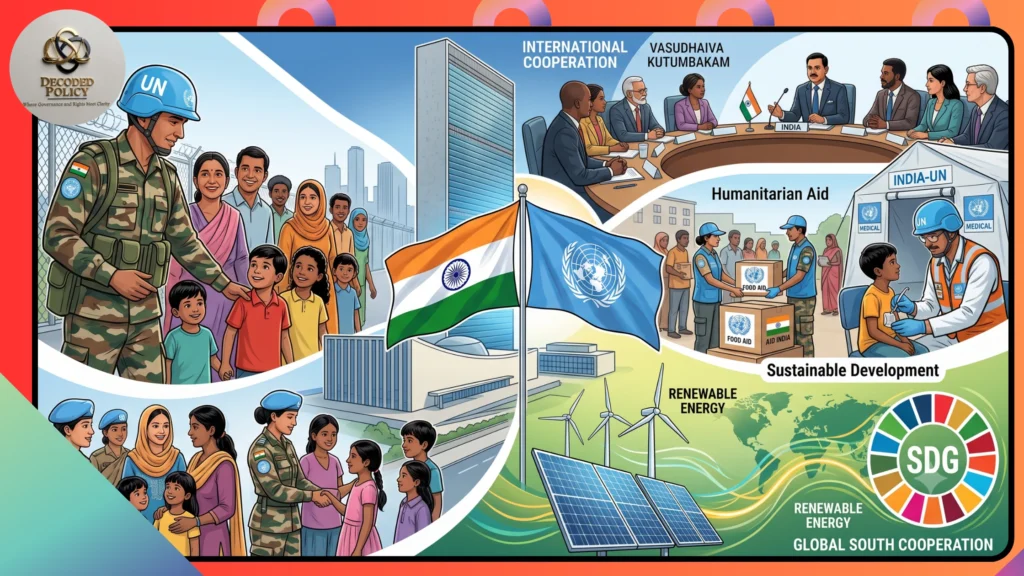
India is a founding member of the United Nations and has consistently supported international peace, security, and multilateral cooperation since its inception. Today, India has established itself as a responsible global partner within the UN. Over the past few decades, India has made significant contributions, as outlined below:
UN Peacekeeping Missions – India has been one of the world’s largest troop-contributing nations. Thousands of Indian soldiers have contributed to maintaining peace and protecting civilians in conflict-affected regions across Africa, Asia, and the Middle East.
Humanitarian Assistance – India has provided medicines, food supplies, and emergency relief to numerous countries during earthquakes, floods, wars, and natural disasters.
Climate Action – India supports the Paris Agreement and has launched initiatives like the International Solar Alliance (ISA) to promote renewable energy.
Sustainable Development Goals (SDGs) – India is working towards achieving the SDGs through efforts focused on poverty reduction, digital inclusion, clean energy, sanitation, and healthcare.
Global Health – During the COVID-19 pandemic, India supplied vaccines and essential medicines to many countries under the “Vaccine Maitri” initiative, thereby strengthening global health cooperation.
Conclusion
In today’s interconnected world, no single country can solve every global problem on its own. That is why the role of the United Nations has become more important than ever. Whether it concerns peacekeeping, humanitarian assistance, climate change, or sustainable development, the UN provides a common platform for countries to work together. The UN also encourages countries to strengthen good governance, transparency, and international cooperation to build a more peaceful and sustainable world. If the organization implements timely reforms and all member countries continue to strengthen their cooperation, the United Nations will remain a reliable and effective global institution for the world in the future.









बहुत अच्छी जानकारी के लिए
Nice work man … appreciated