Introduction: Understanding the Meaning of Civil Society
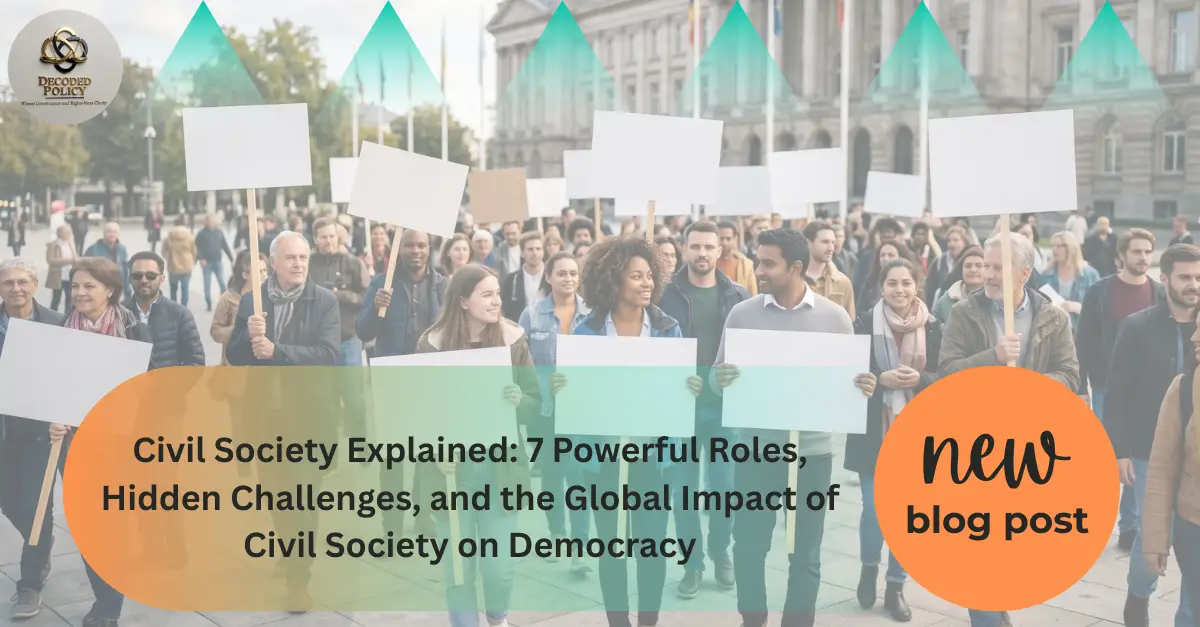
In today’s modern democratic society, the government is not the only one in control. Ordinary citizens and independent organizations also play an important role in social development, public awareness, human rights protection, and maintaining accountability.
These groups, organizations, unions, NGOs, activists, media groups, and community networks are collectively called civil society.
The concept of civil society is deeply connected to democracy and public participation. When citizens voluntarily organize for their common interests, rights, environment, education, corruption, or social justice, they become part of civil society.
The main objective of civil society is not just to criticize but to bring about positive change in society and the governance system. Civil society acts as a bridge between the government and the private business sector, strengthening democracy by highlighting public issues.
Therefore, civil society is seen as a major pillar in making democracy active and participatory.
The Scope of Civil Society: Beyond Government and Business
The scope of civil society is very wide and dynamic as it influences almost every social, political, and developmental sector of society. The scope of civil society is not limited to NGOs or protest movements.
It creates a special social space beyond the government and private business sector where citizens can freely express their concerns and interests. This includes community organizations, media groups, trade unions, student bodies, women’s associations, human rights organizations, and religious or cultural groups.
In a democratic society, civil society acts as a bridge that maintains a balance between citizens, government, and market forces. It not only monitors the policies of the government but also makes the citizens aware, organized, and empowered.
This is why civil society is considered an essential pillar in the discussion of modern democracy and good governance.
7 Powerful Roles of Civil Society in a Democracy
- Creating Public Awareness- Civil society organizations make citizens aware of constitutional rights, public policy, RTI, voting rights, and government schemes. Example: RTI awareness campaigns in India increased transparency and citizen participation.
- Acting as a Watchdog- Civil society monitors government actions, corruption, misuse of power, and policy implementation to maintain accountability and transparency. Example: The India Against Corruption movement exposed corruption issues and demanded stronger anti-corruption laws.
- Influencing Public Policy– NGOs, activists, and advocacy groups influence government decisions and policy reforms through campaigns, reports, and public pressure. Example: Environmental groups have influenced policies related to pollution control and climate action.
- Protecting Human Rights and Social Justice- Civil society raises its voice for the rights of marginalized communities, women, minorities, and weaker sections. Example: Amnesty International works on global human rights protection and justice issues.
- Encouraging Citizen Participation- Civil society makes democracy participatory by encouraging citizens to engage in elections, debates, protests, and governance discussions.
- Providing Social Welfare and Humanitarian Support- Many organizations run education, healthcare, disaster relief, and poverty reduction programs for community development. Example: Akshaya Patra Foundation provides meals to school children across India.
- Promoting Environmental Protection and Sustainable Development- Civil society supports environmental conservation, climate awareness, and sustainable development goals. Example: Greenpeace runs campaigns against environmental destruction and climate change.
Civil Society and Policy Advocacy: Influencing Government Decisions
In a democracy, government policies are not shaped solely by political leaders or bureaucrats. Civil society also strongly influences public opinion and policy implementation.
Public advocacy is a powerful function of civil society, in which independent organizations and citizens’ groups seek to influence government decisions for the public welfare and good governance.
These organizations identify public interest issues and demand reform through campaigns, reports, public debates, and legal activism. This process makes the governance system more participatory and accountable.
A strong real-world example of the policy advocacy role of civil society is India’s RTI movement. Civil society groups like Mazdoor Kisan Shakti Sangathan raised demands for transparency, accountability, and reform in public administration.
These organizations created pressure on the government through public campaigns, protests, and citizen participation, which led to the enactment of the Right to Information Act 2005.
Today, RTI is considered an important pillar of India’s e-governance and democratic governance system because it gives citizens the right to monitor government records and policy implementation.
The Watchdog Function: Strengthening Accountability and Transparency
One of the most important roles of civil society is its “watchdog function,” in which independent organizations, media groups, activists, and citizen networks monitor government actions and public administration.
Their main objective is to strengthen accountability and transparency so that power is not misused and the governance system functions in accordance with democratic principles.
Civil society creates public awareness by exposing issues such as corruption, misuse of public funds, weak policy implementation, and abuse of authority.
Positive Contributions of Civil Society to Democracy
- Civil society makes democracy more active and participatory by increasing citizen participation and public engagement.
- Civil society organizations improve transparency in the governance system by exposing corruption and misuse of power.
- They encourage inclusive development by supporting the rights of marginalized communities, women, and vulnerable groups.
- Through policy advocacy and public awareness, civil society influences the government to formulate more people-oriented public policies.
- Civil society strengthens good governance by promoting transparency, decentralization, digital awareness, and efficient public administration.
Hidden Challenges and Criticism of Civil Society Organizations
- Lack of Transparency in Some Organizations– Some civil society organizations themselves do not maintain proper accountability and financial transparency, which has affected public trust.
- Political Influence and Bias– Many organizations appear to be criticized for being influenced by political ideology or party interests, which can reduce neutrality.
- Foreign Funding Concerns– Some NGOs are criticized on issues of foreign funding and external influence, especially in sensitive public policy matters.
- Unequal Representation– Not every civil society group represents the whole society, and sometimes the voices of rural or weaker communities are ignored.
- Pressure Tactics and Excessive Activism– Some movements have created excessive pressure on governments through protests and campaigns, which may sometimes disrupt public administration and policy implementation.
- Limited Grassroots Impact– Many organizations remain limited to urban areas and cannot create the expected impact on local governance, decentralization, and rural development.
- Conflict with Government Institutions– Conflicts between civil society and government sometimes slow down the governance process and development projects.
- Spread of Misinformation and Digital Activism Risks– Social media activism and digital campaigns sometimes spread incomplete information or misinformation, affecting democratic governance and public opinion.
Example– A recent example of the opportunities and risks of digital-age civil society can be seen in the viral discussions around the so-called “Cockroach Janta Party (CJP)” trend on social media.
The movement gained massive attention within a very short time because it raised emotionally relatable public concerns, such as unemployment, problems in the education system, examination paper leaks, governance reforms, and frustration among the youth. Many of these issues are genuine and deserve serious discussion in a democracy.
However, the situation also showed how quickly online activism can influence public opinion without proper fact-checking or contextual understanding.
A large number of users appeared to support or follow the trend without verifying whether it was an actual registered political organization, understanding the original statement that triggered the trend, or examining the broader context behind it.
This highlights an important challenge in the digital era: while social media has made civic participation faster and more accessible, it has also increased the risk of emotional reactions, misinformation, and crowd-driven narratives influencing democratic discourse more than informed public understanding.
Global Impact: How Civil Society Influences International Politics
After globalization and the growth of digital communication, the international influence of civil society organizations has increased significantly.
These organizations put pressure on governments for policy reform and transparency through international forms or media platforms. Human rights organizations, environmental groups, humanitarian networks, and global advocacy moments can influence international public policy discussion.
These organizations create pressure on governments or international institutions on global issues like climate change, refugee rights, gender equality, peacebuilding, and sustainable development. For example, Amnesty International highlights human rights violations globally.
Case Studies of Influential Civil Society Movements
India Against Corruption Movement
The India Against Corruption movement officially came to nationwide attention around the period 2010–2011.
This movement was launched mainly against corruption and the weak accountability system. Protests, hunger strikes, and public campaigns were organized under the leadership of social activist Anna Hazare.
The main demand of the movement was the implementation of the Jan Lokpal Bill and stronger anti-corruption mechanisms. This campaign received massive public support from students, middle-class citizens, activists, and digital media platforms.
This movement made issues like transparency, RTI awareness, governance reforms, and citizen participation a major part of the national political discussion.
Greenpeace
Greenpeace was founded in 1971 by a small group of environmental activists in Canada. The organization initially became known for its campaigns against nuclear testing and environmental destruction.
Over time, Greenpeace became active on global issues such as climate change, deforestation, ocean pollution, renewable energy, and sustainable development. The organization creates pressure on governments and multinational corporations for environmental accountability through peaceful protests, research reports, digital activism, and international awareness campaigns.
Today, Greenpeace is considered one of the most influential examples of global civil society and environmental governance.
Major Examples of Civil Society Organizations and Movements
| Organization / Movement | Country | Founded In | Founded By | Impact After Formation |
| Mazdoor Kisan Shakti Sangathan | India | 1990 | Aruna Roy, Nikhil Dey, and Shankar Singh | Its transparency campaigns and public pressure forced the government to strengthen accountability mechanisms, which later contributed to the implementation of the RTI Act and greater openness in local governance. |
| India Against Corruption | India | 2010 | Anna Hazare and other activists | Massive protests and citizen mobilization created strong pressure on the government to discuss anti-corruption reforms and strengthen mechanisms related to transparency and institutional accountability. |
| Self Employed Women’s Association | India | 1972 | Ela Bhatt | Its activism pushed policymakers to focus more on women workers’ rights, financial inclusion, self-employment opportunities, and labour welfare reforms. |
| Greenpeace | Canada | 1971 | Irving Stowe, Dorothy Stowe, and other activists | Its global environmental campaigns pressured governments and corporations to adopt stricter climate policies, pollution controls, and sustainability measures. |
| Amnesty International | United Kingdom | 1961 | Peter Benenson | Its human rights reports and international campaigns forced many governments to respond to global criticism regarding political prisoners, torture, and civil liberties violations. |
| Doctors Without Borders | France | 1971 | Bernard Kouchner and other doctors/journalists | Its humanitarian work and crisis reporting pressured governments and international institutions to improve emergency healthcare responses and humanitarian support systems during conflicts and disasters. |
The Future of Civil Society in the Digital Age
With the rapid growth of digital technology and social media, the future of civil society appears dynamic and influential.
Today, online platforms have made citizen participation, public awareness, and policy advocacy faster and more accessible. Activists, NGOs, youth groups, and independent organizations are now influencing governance issues and public policy discussions through digital campaigns, online petitions, webinars, and social media movements. Additionally, online awareness campaigns and global connectivity have made it easier for local issues to reach international attention.
But the digital age has also brought increased challenges, such as misinformation, emotional mobilization, online polarization, and fake narratives.
Therefore, responsible digital activism, fact-checking, media literacy, and informed public participation will be extremely important for democratic stability in the future.
12. Conclusion: Why Civil Society Remains Essential for Democracy
A democratic society is not successful just by elections; Active citizen participation and independent organizations are also equally important.
In conclusion, civil society plays an extremely important role in making democracy stronger, more transparent, and citizen-centered. These actively involve citizens in public participation, accountability, policy awareness, and governance discussions. NGOs, activists, media groups, and community organizations highlight important issues like social justice, environmental protection, transparency, and democratic rights.
However, in the rapidly growing era of digital activism and social media influence, the importance of responsible civic engagement has increased even more. If citizens remain informed and aware, it is possible to make democracy more stable, inclusive, and people-oriented.
Overall, civil society is an essential pillar of modern democracy because it connects citizens with governance and public decision-making processes.