Introduction to Artificial Intelligence and Governance
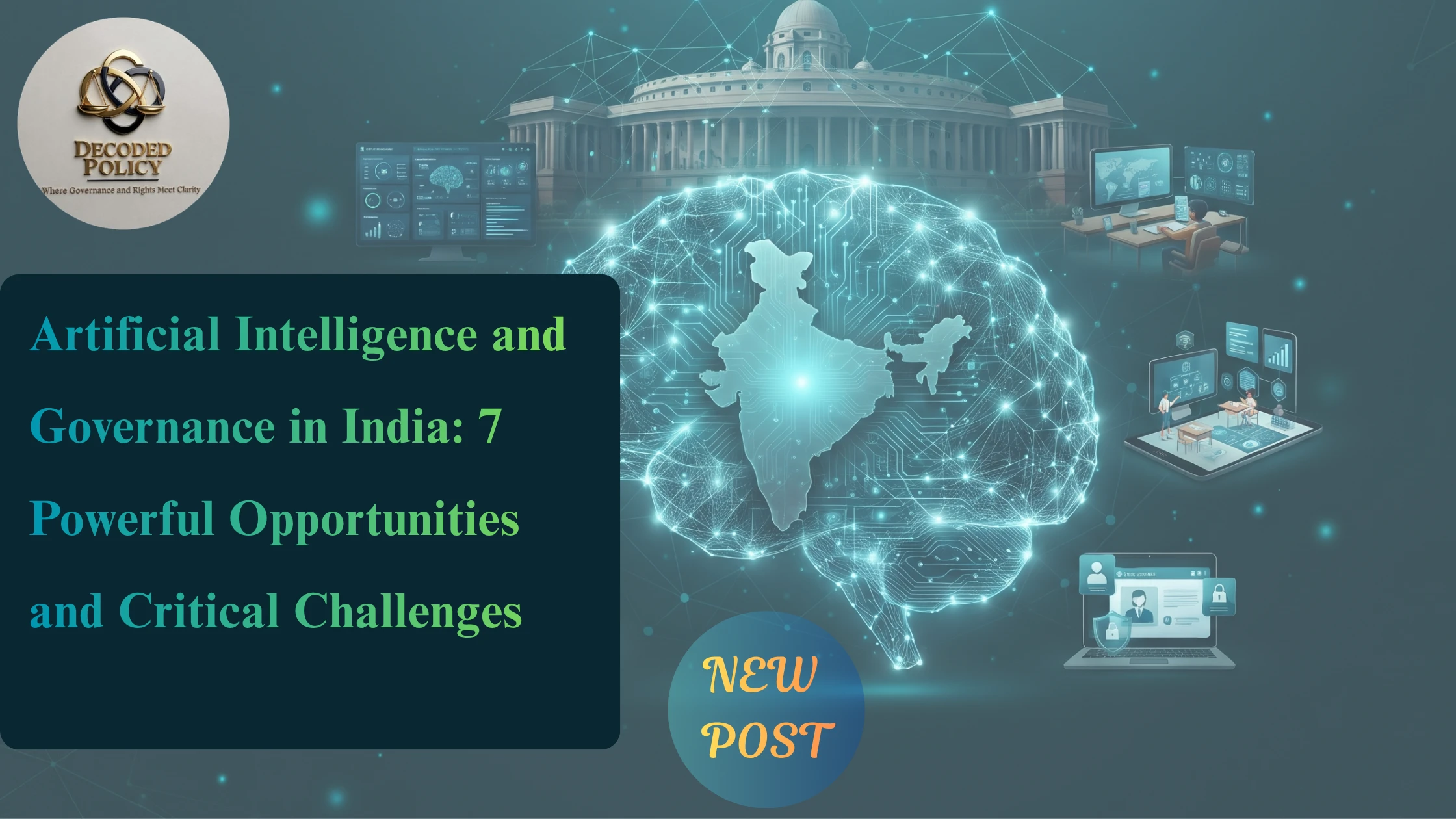
Artificial Intelligence and Governance have become increasingly interconnected in modern societies. Governments are exploring AI technologies to improve public service delivery, administrative efficiency and evidence-based policymaking.
Artificial Intelligence (AI) has become a significant development in the world of technology today. It refers to technology that enables machines and computer systems to perform tasks in a manner similar to human intelligence—such as learning, problem-solving, decision-making, and data analysis.
In the context of governance, the role of AI is becoming increasingly important. Governments can leverage AI to improve public services, accelerate administrative processes, and make better policy decisions by analyzing large-scale data. In this way, AI can help make traditional governance systems more efficient and responsive.
Artificial Intelligence is creating new opportunities within India’s governance system. AI-based technologies can be applied to areas such as public service delivery, healthcare support, agricultural advisory services, language translation, and government decision-making.
In India, efforts are underway to strengthen digital infrastructure and the AI ecosystem through initiatives like the Digital India Programme, the IndiaAI Mission, and other technology-driven projects. However, the adoption of AI also necessitates addressing challenges such as data protection, digital inequality, ethical concerns, and institutional accountability.
Therefore, it is important to view Artificial Intelligence not merely as a technological advancement, but as an emerging instrument for public policy and governance.
Meaning and Scope of Artificial Intelligence
Meaning of Artificial Intelligence
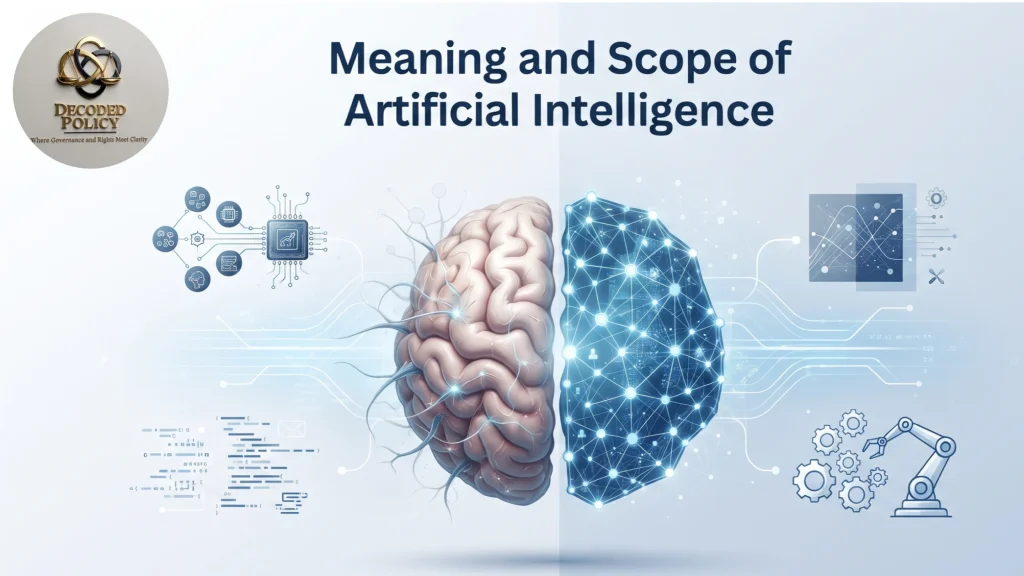
Artificial Intelligence (AI) is a branch of computer science that enables machines and computer systems to perform tasks that typically require human intelligence.
This includes tasks such as learning, problem-solving, language understanding, pattern recognition, and decision-making. AI systems use data and algorithms to analyze information and generate outputs based on that analysis. Today, AI is being utilized across various sectors, including healthcare, education, agriculture, and public administration.
Scope of Artificial Intelligence in Modern Society
In modern society, the scope of Artificial Intelligence is continuously expanding. Today, the use of AI is not limited solely to technology-based industries; its influence is also growing in daily life, business, transportation, communication, and financial services.
Online shopping recommendations, digital payment security, virtual assistants, and smart transportation systems are common examples of this. Furthermore, AI is helping to improve productivity and simplify complex tasks across various sectors.
Evolution and Development of Artificial Intelligence
The development of Artificial Intelligence (AI) has been a gradual process involving decades of research and technological advancements. Its early foundation can be traced back to 1950, when British mathematician Alan Turing explored the concept of machine intelligence and introduced the idea of the Turing Test.
In 1956, the Dartmouth Conference marked an important milestone, where John McCarthy formally introduced the term ‘Artificial Intelligence’ and established it as a field of research.
During the initial years, AI development faced several limitations due to insufficient computing power, limited data and technological challenges. However, improvements in computer technology gradually created new opportunities for AI research.
In 1997, IBM’s Deep Blue defeated world chess champion Garry Kasparov, demonstrating the growing capabilities of computer systems. Later, the development of Machine Learning and Deep Learning brought significant improvements in areas such as image recognition, speech processing and data analysis.
In 2016, Google’s AlphaGo defeated professional Go player Lee Sedol, marking another major achievement in AI development.
In recent years, the emergence of Generative AI has further expanded the capabilities of this technology. The public launch of ChatGPT in November 2022 brought AI into wider public discussion and demonstrated its potential to generate human-like text and respond to complex queries.
Today, AI has moved beyond research laboratories and become an important part of businesses, educational institutions, healthcare and public administration.
Difference Between Artificial Intelligence and Traditional Computing
| Basis | Traditional Computing | Artificial Intelligence |
| Meaning | Performs tasks based on predefined instructions. | Performs intelligent tasks using data and algorithms. |
| Approach | It follows a rule-based approach. | A data-driven and learning-based approach can be used instead. |
| Output | It produces output primarily according to predefined rules. | It generates output based on input and learned patterns. |
| Data Analysis | Performs fixed queries and programmed operations. | Can identify patterns and trends in large datasets. |
| Public Service Delivery | It is used for online forms, records, and basic service processing. | It can be used for chatbots, automated assistance, and intelligent service support. |
| Examples | Calculator, basic billing software and traditional database systems. | Chatbots, facial recognition and recommendation systems. |
Role of Artificial Intelligence in Governance
The main objective of governance is to provide accessible, efficient and quality public services to citizens. Artificial Intelligence provides new opportunities to strengthen the process, especially in e-governance and citizen-oriented administration.
The role of Artificial Intelligence and Governance is becoming increasingly important as governments adopt technology to improve decision-making, transparency and public service delivery.
- Improving Administrative Efficiency: AI helps reduce the workload of government departments by automating repetitive administrative tasks.
- Better Policy Formulation: By analyzing large datasets, AI supports policymakers in understanding public needs and existing problems.
- Public Service Delivery: AI-based chatbots and digital platforms enable citizens to easily access government services and basic information.
- Monitoring and Evaluation: AI can be useful in monitoring the progress of government schemes and development programs.
- Resource Management: AI can assist in improving the planning and utilization of available resources.
- Public Participation: By analyzing public feedback and citizen responses, AI can help policymakers understand the concerns of the people.
Applications of Artificial Intelligence in Different Sectors
The use of artificial intelligence is expanding rapidly across various sectors today. Artificial Intelligence and Governance are also becoming increasingly important as governments explore new ways to improve public administration and service delivery. With the advancement of technology, AI is helping to improve working methods and find solutions to existing problems in fields such as healthcare, education, agriculture, and other industries.
1. Healthcare
AI is being used to analyse medical images, support early detection of diseases and improve patient care.
India Example: In India, the AI-based Cough Against TB solution is being used to support the screening of pulmonary tuberculosis. Apart from this, an AI-powered Clinical Decision Support System (CDSS) integrated into e-Sanjeevani provides assistance to doctors during teleconsultations.
2. Education
AI-based learning platforms provide personalised study materials and educational assistance according to the learning requirements of students.
India Example: The Ministry of Education’s DIKSHA platform uses AI-based features such as keyword-based searches in educational videos and read-aloud facilities to improve learning accessibility. CBSE has also introduced a Computational Thinking and Artificial Intelligence curriculum for Classes 3 to 8 from the 2026–27 academic session.
3. Agriculture
AI supports farmers in crop monitoring, pest detection, agricultural planning and the analysis of weather and soil-related information.
India Example: The Government of India’s Kisan e-Mitra is an AI-powered chatbot developed to assist farmers with queries related to the PM-KISAN scheme, with its services evolving to cover other government programmes. The National Pest Surveillance System (NPSS) also uses AI and Machine Learning to identify crop pests and diseases and provide timely agricultural advisories.
4. Banking and Finance
Financial institutions use AI to improve fraud detection, risk assessment and customer support services.
India Example: The Reserve Bank Innovation Hub (RBIH) has developed MuleHunter.AI, an AI and Machine Learning-based system that helps banks identify suspicious mule bank accounts. According to the RBI Annual Report 2025–26, the system had been implemented in 26 banks as of March 31, 2026.
5. Transportation
AI is playing an important role in traffic management, route optimisation and the development of autonomous vehicle technologies.
India Example: The Ministry of Road Transport and Highways is promoting Advanced Traffic Management Systems (ATMS) on National Highways. These systems include AI-based Video Incident Detection and Enforcement Systems (VIDES) and Automatic Number Plate Recognition (ANPR) cameras to detect road incidents, support traffic enforcement and improve road safety.
6. Public Administration
Government departments can use AI-based tools to analyse public complaints, manage records and monitor welfare schemes.
India Example: The Government of India’s BHASHINI platform provides AI-based language translation and speech services, enabling citizens to access digital information and public services in different Indian languages.
Challenges and Risks of Artificial Intelligence in Governance
The use of AI in governance is not merely a matter of technological development; it is also directly linked to citizens’ rights, transparency, and institutional accountability. Artificial Intelligence and Governance must therefore be approached with a focus on responsible use, ethical standards, and public interest. If the data used to train AI systems contains social, economic, or gender-based biases, the decisions made by these systems can also be discriminatory.
Furthermore, a lack of transparency in automated decision-making can make it difficult for citizens to understand why a specific decision was reached regarding their applications, benefits, or complaints. Issues such as data protection, surveillance, cybersecurity, and a lack of human oversight also pose significant challenges.
Artificial Intelligence in India: Key Government Initiatives and Policy Framework
The Government of India has introduced several significant initiatives to promote the development and adoption of Artificial Intelligence (AI) in the country. These efforts reflect the growing importance of Artificial Intelligence and Governance in India’s public policy and digital transformation agenda.
In June 2018, NITI Aayog released the National Strategy for Artificial Intelligence, with the vision of #AIforAll. This strategy focused on fostering inclusive growth by leveraging AI across sectors such as healthcare, agriculture, education, smart cities, and mobility.
A major step in this direction was the approval of the IndiaAI Mission on 7 March 2024, with a financial outlay of ₹10,371.92 crore over a five-year period.
The mission is built upon seven pillars: AI computing infrastructure, indigenous AI models, datasets, application development, skill development, startup financing, and Safe & Trusted AI. By August 2026, the government had reported that 38,000 GPUs had been onboarded under the mission.
Furthermore, the government has promoted AI-driven language translation and speech technologies through initiatives like BHASHINI, launched in July 2022 under the National Language Technology Mission.
It aims to reduce language barriers and enhance access to digital information and public services in Indian languages. Additionally, the India AI Governance Guidelines, officially unveiled on 5 November 2025, provide a framework for the safe, responsible, inclusive, and trustworthy development and adoption of AI.
Complementing these efforts, the Digital Personal Data Protection Act, 2023 and the Digital Personal Data Protection Rules, 2025 establish a broader legal framework for the processing and protection of digital personal data.
While these are not AI-specific laws, they are relevant to the responsible use of personal data within AI systems. The Rules were notified in November 2025, with a phased commencement schedule for their various provisions.
AI Governance: Global Approaches and International Examples
As Artificial Intelligence continues to expand across different sectors, countries and international organizations are developing policies and regulatory frameworks to ensure its safe, ethical and responsible use. Although their approaches differ, many of these efforts focus on balancing technological innovation with human rights, transparency, accountability and public interest.
Global Approaches and International Examples
1. European Union – Risk-Based Regulatory Approach
The European Union adopted the Artificial Intelligence Act (AI Act) in 2024, establishing a risk-based regulatory framework for AI systems. It classifies AI applications according to their potential risks, imposing stricter requirements on high-risk systems used in areas such as healthcare, education and employment. The approach aims to protect fundamental rights and public safety while encouraging responsible innovation.
2. United States – AI Risk Management Framework
In the United States, the National Institute of Standards and Technology (NIST) has promoted innovation alongside voluntary risk-management standards. In January 2023, NIST released the AI Risk Management Framework (AI RMF 1.0) to help organizations identify, assess and manage risks associated with AI systems. It focuses on developing trustworthy AI while protecting individuals, organizations and society from potential harm.
3. China – State-Led Regulatory Approach
China has introduced specific regulations to govern algorithmic recommendation services and generative AI applications. Its Interim Measures for the Management of Generative Artificial Intelligence Services, issued in 2023, aim to promote the development of generative AI while addressing concerns related to information security, public interest and users’ rights. This reflects a more state-directed approach to AI regulation.
4. OECD – Principles for Trustworthy AI
The Organisation for Economic Co-operation and Development (OECD) adopted its AI Principles in 2019 and updated them in May 2024. These principles promote innovative and trustworthy AI based on human rights, democratic values, transparency, accountability, safety and inclusive growth. They provide policy guidance to governments and help encourage international cooperation on AI governance.
5. UNESCO – Ethical and Human-Centric AI
UNESCO adopted the Recommendation on the Ethics of Artificial Intelligence in November 2021, with 193 Member States at its General Conference adopting the framework. It provides a global framework for the ethical development and use of AI, emphasizing human rights, fairness, privacy, transparency, human oversight and environmental sustainability. It encourages governments to develop appropriate institutional and policy frameworks for responsible AI adoption.
Way Forward: Building Responsible and Inclusive AI Governance in India
India has taken several important steps towards building a responsible AI ecosystem through initiatives such as the IndiaAI Mission, India AI Governance Guidelines and the Digital Personal
Data Protection framework. However, further efforts are required to ensure their effective implementation, strengthen transparency and accountability, protect citizens’ privacy and expand access to AI technologies, particularly in rural and disadvantaged communities.
Greater investment in research, skill development, indigenous innovation and public-private partnerships, along with stronger institutional capacity and international cooperation, can help India promote responsible and inclusive AI governance. Ultimately, AI should support human decision-making, strengthen Good Governance and improve public service delivery.
Conclusion
Artificial Intelligence is transforming the way governments function and deliver public services. Artificial Intelligence and Governance have become increasingly important in shaping modern public administration and improving the delivery of government services. In India, it offers significant opportunities to improve administrative efficiency, strengthen policy implementation and promote inclusive development.
However, challenges related to data privacy, algorithmic bias, transparency and accountability cannot be ignored. Therefore, the success of AI in governance will depend not only on technological advancement but also on responsible implementation, effective regulation and human oversight.
By balancing innovation with citizens’ rights and public interest, India can harness the potential of Artificial Intelligence to strengthen Good Governance and build a more transparent, efficient and inclusive society.