Introduction
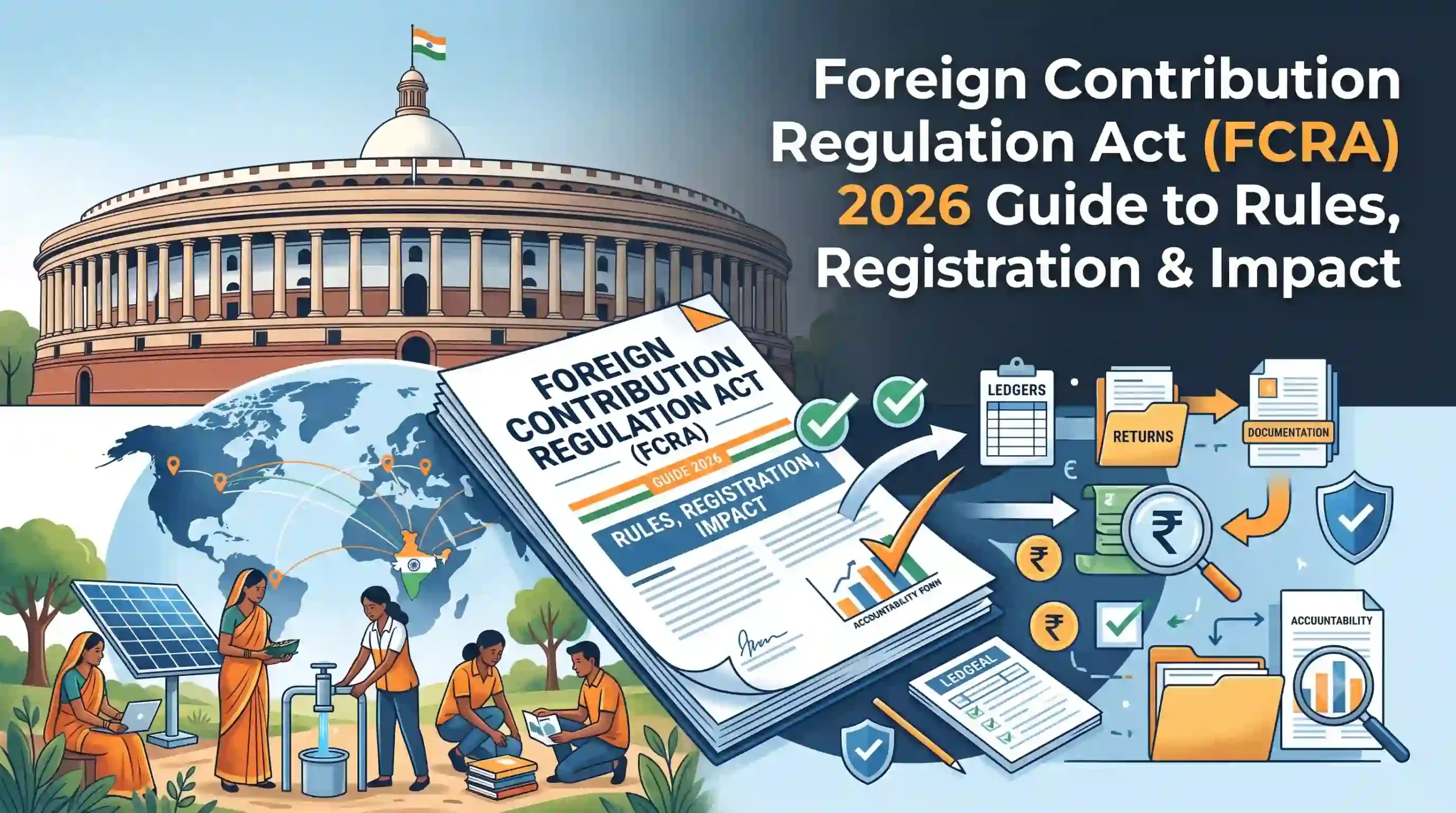
Imagine an NGO in India working for the education of underprivileged children that receives donations from the US or the UK. Can such donations be received directly? Is government permission required for this? The Foreign Contribution Regulation Act (FCRA) was enacted in India to regulate this very process.
Currently, this law is back in the headlines because the 2026 Amendment Bill is being discussed in Parliament. Therefore, the FCRA is significant not only for NGOs but also for students, researchers, and any citizen interested in understanding Indian governance and public policy.
In this guide, we will explain the FCRA in simple language so that you can easily understand the law, even without a legal background.
What is the Foreign Contribution Regulation Act (FCRA)?
Simply put, the Foreign Contribution Regulation Act (FCRA) is an Indian law that governs who in India may receive foreign donations or funding and how those funds may be used. The primary objective of this law is to ensure that foreign funds are used solely for genuine social work and are not misused.
Nowadays, many Indian NGOs receive foreign funding for projects related to education, healthcare, the environment, and disaster relief. However, the government also seeks to ensure that these funds are not used in a manner contrary to India’s national interest; this is why the Foreign Contribution Regulation Act (FCRA) was enacted.
For instance, consider an NGO in Bihar working to educate underprivileged children. If this NGO receives a donation of ₹20 lakh from a charitable foundation in the UK, it must comply with FCRA regulations to receive and utilize that donation.
History and Evolution of the Foreign Contribution Regulation Act (FCRA)
The journey of the FCRA spans nearly 50 years. The government has updated this law every few years to make it more effective in light of changing circumstances.
1976 – Beginning of FCRA
The Foreign Contribution Regulation Act (FCRA) was first introduced in India in 1976. At that time, the government was concerned that funds coming from foreign countries or organizations might influence India’s politics, media, and social organizations. Therefore, a law was enacted to ensure proper monitoring and control over foreign funding.
The FCRA 1976 established the first legal framework in India to regulate foreign contributions. The Act determined who could receive foreign donations, which individuals and organizations would be subject to restrictions, and in which instances prior permission from the Central Government would be mandatory. Its primary focus was to exercise basic control over foreign funding and safeguard national security.
Why was a new Act enacted in 2010?
The FCRA 1976 remained in force for approximately 34 years. During this period, the number of NGOs in India grew significantly, and the volume of foreign funding increased manifold. However, the 1976 Act had become outdated in the face of changing times. Various practical challenges regarding registration, monitoring, and transparency were emerging.
For instance, if an NGO received foreign donations but failed to maintain proper records or submit timely reports, it became difficult for authorities to verify how the funds were being utilized and whether they were being used for the declared purpose. As the scale of foreign funding increased, the existing legal framework was no longer sufficient to ensure effective oversight.
Addressing this need, the government enacted the Foreign Contribution Regulation Act (FCRA), 2010, replacing the 1976 Act. The objective of the new law was not merely to regulate foreign funding but also to strengthen transparency, accountability, and effective monitoring.
The Foreign Contribution Regulation Act (FCRA) 2010 introduced a proper framework for registration and renewal. The validity of FCRA registration for NGOs was set at five years, after which renewal became mandatory. Additionally, maintaining complete records of foreign contributions and filing annual returns were made compulsory, enabling the government to easily monitor the sources and utilization of funds.
The law also granted the government clear powers to suspend or cancel registration if an organization violated FCRA rules or misused foreign funds. These changes made the FCRA 2010 far more transparent, accountable, and effective than its predecessor, establishing a clear compliance framework for both genuine NGOs and regulatory authorities.
FCRA Amendment 2020
The FCRA 2010 remained in effect for nearly a decade. During this period, the government held the view that certain organizations were misusing foreign contributions and that, despite existing regulations, there was a need to further strengthen monitoring and accountability mechanisms. Consequently, the Foreign Contribution (Regulation) Amendment Act, 2020, was introduced with the primary objective of making the tracking of foreign funds more transparent and effective.
To put it simply, if an NGO received a foreign donation and transferred a portion of those funds to another NGO, it became difficult for authorities to track the ultimate utilization of the original funds. Concerns were also raised regarding excessive spending on administrative expenses. To address these practical issues, the government tightened the law in 2020.
Several significant changes were introduced under the FCRA Amendment 2020. It became mandatory to receive all foreign contributions through a designated FCRA account at the SBI New Delhi Main Branch; restrictions were imposed on the transfer of foreign contributions from one NGO to another (sub-granting); the limit for administrative expenses was reduced from 50% to 20%; and Aadhaar or Passport identification was made mandatory for office bearers. The aim of these changes was to make foreign funding more transparent, accountable, and easily traceable.
FCRA Amendment Bill 2026
After approximately six years, the government realized that certain practical and legal issues persisted even following the FCRA Amendment Act of 2020. To address these matters, the Foreign Contribution (Regulation) Amendment Bill, 2026, was introduced in Parliament. It is important to note that this Bill is currently under discussion in Parliament and has not yet been enacted into law; therefore, the FCRA Act, 2010 (as amended in 2020), remains in force for the time being.
To put it simply, the existing Act lacked a clear legal mechanism for managing the remaining foreign funds and assets acquired through such funds in cases where an NGO’s FCRA registration expired, was surrendered, or was cancelled. The government proposed the 2026 Amendment Bill to bridge this gap. The Bill includes a provision to appoint a ‘Designated Authority’ responsible for the custody and management of foreign-funded assets and funds in such instances, thereby preventing misuse and ensuring legal clarity.
If the Foreign Contribution Regulation Act (FCRA) Amendment Bill, 2026, is passed by Parliament, it will introduce new provisions to the FCRA Act, 2010, and further clarify the compliance framework for NGOs. The primary focus of this Bill is not to halt foreign funding but to legally regulate the management of foreign contributions and the assets derived from them after the registration ceases to exist. Consequently, this Bill has become a significant topic of interest for NGOs, policymakers, legal experts, and students of public policy.
FCRA Evolution at a Glance
| Year | Key Change |
|---|---|
| 1976 | First FCRA law introduced to regulate foreign funding and prevent foreign influence in politics, media, and national security. |
| 2010 | New FCRA Act replaced the 1976 Act; introduced 5-year registration, mandatory renewal, annual returns, and stronger compliance. |
| 2020 | Mandatory SBI New Delhi FCRA account, ban on sub-granting, administrative expense limit reduced to 20%, and stricter identification requirements. |
| 2026* | Proposed Amendment Bill to introduce a Designated Authority for managing funds and assets when an NGO’s FCRA registration expires, is surrendered, or is cancelled. |
The Foreign Contribution Regulation Act (FCRA) Registration Process Explained
If an NGO, Trust, Society, or Section 8 Company wishes to receive foreign contributions, obtaining Foreign Contribution Regulation Act (FCRA) registration is mandatory. Without registration, an organization cannot legally accept foreign donations. If an organization is not yet eligible for full registration, it can receive foreign contributions for a specific donor and project through the ‘Prior Permission’ route.
Step 1: Check Eligibility
First, the organization must verify its eligibility for FCRA registration. For general registration, the organization must be at least three years old and have spent ₹15 lakh or more on social work in its chosen field. If these conditions are not met, the organization can apply for ‘Prior Permission’ (Form FC-3B).
Step 2: Open an FCRA Bank Account
Before submitting the application, the organization must open a designated FCRA account at the State Bank of India (SBI), New Delhi Main Branch (NDMB). Foreign contributions are initially received in this account. Subsequently, funds can be transferred to other utilization accounts as needed.
Step 3: Apply Online
Next, the organization must submit an online application via the FCRA Online Portal. Form FC-3A is used for general registration, while Form FC-3B is used for Prior Permission. Along with the application, the organization must upload its Darpan ID, registration documents, bank details, and other required supporting documents.
Step 4: Verification by the Government
Once the application is submitted, the Ministry of Home Affairs (MHA) verifies the documents and the organization’s activities. If all conditions are met, an FCRA Registration Certificate is issued to the organization for a period of five years. Upon receiving registration, the organization can legally accept foreign contributions.
Step 5: Compliance After Registration
The NGO’s responsibilities do not end with obtaining registration. The organization is required to file an Annual Return (Form FC-4) every year, maintain proper records of foreign contributions, and adhere to all FCRA regulations. The registration is valid for five years; therefore, it is essential to apply for renewal before it expires.
Real-Life Case Studies and Examples
Merely reading the legal provisions of the FCRA might not fully convey how it operates on the ground. In recent years, several well-known organizations have made headlines due to FCRA-related issues. These cases illustrate that receiving foreign contributions is not just about accepting donations; it entails legal responsibilities, transparency, and compliance obligations. Let us look at a few important examples.
Example 1: Greenpeace India – How Does FCRA Work in Practice?
In 2015, Greenpeace India was frequently in the news regarding the Foreign Contribution Regulation Act (FCRA). The organization received funding from foreign donors and worked on environmental issues. During an investigation, the government noted alleged violations of FCRA norms, such as concerns related to foreign funds and banking compliance. Subsequently, acting under FCRA provisions, the government cancelled the organization’s registration. Greenpeace India challenged this decision in court and presented its case.
This case demonstrates that the FCRA is not merely a law for granting registration. The government also monitors the compliance of organizations receiving foreign contributions and can suspend or cancel their registration if alleged rule violations are found. At the same time, the organization retains the legal right to challenge the government’s decision in court.
Example 2: Rajiv Gandhi Foundation (RGF) & Rajiv Gandhi Charitable Trust (RGCT) Case (2022)
In 2022, the Ministry of Home Affairs (MHA) cancelled the FCRA registration of the Rajiv Gandhi Foundation (RGF) and the Rajiv Gandhi Charitable Trust (RGCT). According to the government, the investigation revealed alleged violations of certain provisions of the Foreign Contribution Regulation Act (FCRA), 2010. Following the cancellation of their registration, both organizations were no longer legally eligible to receive foreign contributions.
This case illustrates that the FCRA is not limited to granting registration; it also empowers the government to monitor organizational compliance and cancel registration if necessary. At the same time, such cases raise a practical question: if an NGO or trust’s FCRA registration is cancelled, what happens to the remaining foreign contribution funds and the assets created using those funds?
With such situations in mind, the Foreign Contribution Regulation Act (FCRA) Amendment Bill, 2026 proposes the appointment of a Designated Authority. If this Bill becomes law in the future, a clear legal framework will be available to manage foreign funds and the assets created from them if a registration expires, is surrendered, or is cancelled.
These examples clarify that the purpose of the FCRA is not to halt foreign funding, but to ensure it is transparent, accountable, and legally regulated. Therefore, it is crucial for any NGO, Trust, Society, or Section 8 Company receiving foreign contributions to strictly comply with FCRA regulations. Failure to adhere to these rules can lead to the suspension or cancellation of registration. Additionally, the 2026 Amendment Bill seeks to further address and clarify certain practical legal gaps.
Criticism and Challenges of the Foreign Contribution Regulation Act (FCRA)
There are varying opinions among experts, NGOs, and policy analysts regarding the FCRA. While some consider it essential for national security, others raise concerns about specific provisions. Here are some of the major criticisms:
- Registration and Renewal Process – Many NGOs state that the registration and renewal processes are excessively lengthy and time-consuming.
- Strict Compliance Requirements – Strict rules regarding annual returns, documentation, and reporting make it difficult for smaller NGOs to maintain compliance.
- Delays in Approval – Some organizations believe that delays in registration or renewal approvals adversely affect their projects and funding.
- Impact on Social Welfare Projects – The suspension or cancellation of FCRA registration can impact projects related to education, healthcare, disaster relief, and rural development.
- Debate on Civil Society – Some experts argue that the FCRA’s strict provisions could affect the functioning of NGOs and the independence of civil society organizations, whereas the government maintains that these measures are necessary for transparency and accountability.
- Foreign Funding Restrictions – Some international organizations believe that stricter rules have made it more challenging for genuine NGOs to receive foreign funding compared to the past.
- Balancing Security and Freedom – The primary challenge lies in ensuring national security, transparency, and financial accountability without subjecting the social work of genuine NGOs to unnecessary difficulties.
Overall, the central debate surrounding the FCRA revolves around striking the right balance between national security and transparency. On one hand, the government aims to prevent the misuse of foreign funding; on the other, NGOs and civil society organizations demand a regulatory system that is transparent, predictable, and efficient.
Impact of the Foreign Contribution Regulation Act (FCRA) on NGOs and Civil Society
The Foreign Contribution Regulation Act (FCRA) has significantly impacted the working environment of NGOs and civil society organizations in India. On one hand, it has established a transparent legal framework for receiving and utilizing foreign contributions; on the other, its strict compliance requirements have affected the day-to-day operations of many organizations.
For NGOs that properly adhere to the Foreign Contribution Regulation Act (FCRA) registration and compliance rules, the process of receiving foreign contributions has become more transparent and accountable. This facilitates the government’s monitoring of the sources and utilization of foreign funds, thereby strengthening good governance, transparency, and accountability while minimizing the risk of misuse.
Conversely, many NGOs feel that compliance requirements—such as registration, renewal, filing annual returns, and maintaining documentation—are quite extensive. Adhering to these rules consistently can be challenging for smaller organizations with limited resources. If an NGO’s FCRA registration is suspended or cancelled, social welfare projects in areas like education, healthcare, women’s empowerment, child welfare, disaster relief, and rural development can be directly affected.
Divergent views exist among civil society members and policy experts regarding the FCRA. Some experts consider it a crucial law for safeguarding national security, ensuring financial transparency, and preventing the misuse of foreign funds. Meanwhile, some NGOs argue that the regulatory framework should balance transparency and accountability with the need to enable genuine organizations to operate efficiently.
Overall, the objective of the Foreign Contribution Regulation Act (FCRA) is not to halt foreign funding but to ensure it is transparent, accountable, and well-regulated. The Act will continue to play a significant role in future discussions concerning public policy, governance, and civil society. Therefore, for NGOs, it is essential not only to obtain FCRA registration but also to consistently adhere to its rules and compliance requirements.
Conclusion
The Foreign Contribution Regulation Act (FCRA) is a crucial legal framework in India for regulating foreign funding. Its primary objective is not to completely restrict foreign contributions but to ensure transparency, accountability, and compliance regarding their source, utilization, and management.
The Foreign Contribution Regulation Act (FCRA) has evolved—from its inception in 1976 through amendments in 2010 and 2020—to effectively address challenges associated with foreign funding. Proposed changes for 2026 also align with this direction, aiming to provide greater clarity on the management of foreign-funded assets and funds in scenarios involving the cancellation, surrender, or expiry of registration.
In the current landscape, NGOs, trusts, and civil society organizations need to understand and properly comply with the Foreign Contribution Regulation Act (FCRA) regulations. A balanced approach is required—one that prevents the misuse of foreign funds while ensuring that genuine organizations continue to receive support for social development initiatives.
Overall, the Foreign Contribution Regulation Act (FCRA) is a vital component of India’s governance framework, serving to maintain a balance of transparency and accountability between foreign contributions and civil society activities.









Great Explanation