In today’s world, governance is no longer limited to traditional files and paperwork. The use of Information and Communication Technology (ICT) has significantly transformed the working style of governments.
This digital transformation is called e-governance, whose main objective is to make services more accessible, responsive, and inclusive.
Today, e-governance has become a medium for interaction between the government and citizens. In India, as well as in other countries around the world, e-governance has played an important role in modernizing public administration.
E-governance strengthens the principles of good governance and promotes citizen participation through decentralization.
Meaning and Scope of E-Governance
Meaning:-
E-governance is a modern approach where technology is used to make governance simple, fast, and citizen-centric. It involves the use of digital platforms, online portals, and electronic systems to make public services easily accessible.
E-governance is not limited to online services but also digitizes decision-making, policy implementation, and public interactions.
Scope:-
The scope of e-governance extends to the national, state, and local levels. It is used in areas such as policy formulation, service delivery, monitoring, and evaluation. Its scope ranges from administrative reforms to citizen participation.
Online applications, digital records, e-payments, grievance portals, and transparency tools are all part of it.
In India, as well as globally, e-governance initiatives are helping to modernize and improve the efficiency of governance systems.
Difference Between E-Governance and E-Government
| E-GOVERNANCE | E-GOVERNMENT | |
| Meaning | E-governance means using information technology in the entire process of governance (such as decision-making, policy implementation, public participation, and administration) to improve transparency, accountability, and efficiency, and to actively include citizens in governance. | E-government means providing government services and administrative functions through digital technology and online platforms, so that citizens can receive faster, easier, and more transparent services. |
| Focus | It aims to improve transparency, accountability, and citizen participation by digitizing the entire governance process. | It focuses on fast and efficient service delivery by making government services and administrative tasks online and digital. |
| Examples | MyGov India Platform Estonia’s E-Participation System | Digilocker Online Passport Seva Portal |
Role of Information Technology in Governance
Information technology plays a crucial role in making the government more efficient and transparent. Digital records, online applications, and automated systems make government work simpler and faster.
The role of IT is not limited to service delivery but extends to policy making, implementation, and public participation. Data analytics and digital tools enable the government to make informed decisions. Its use makes real-time monitoring possible, leading to better implementation of schemes and policies.
It makes governance citizen-centric because online grievance systems and feedback platforms allow the public’s voice to reach the system directly.
Online portals and digital platforms provide citizens with easy access to services and reduce administrative delays, thereby increasing accountability and helping to reduce corruption.
Overall, it can be said that the use of IT makes governance more responsive and inclusive.
E-Governance as a tool for achieving Good GOVERNANCE
E-governance is a powerful tool for achieving good governance. The main objectives of good governance are transparency, participation, and effective administration.
E-governance is not limited to simply using technology, but rather strengthens the democratic values of governance. Digital platforms directly involve citizens in policy discussions and feedback processes, making governance more participatory.
Through this, the government can easily reach marginalized groups, which promotes inclusiveness. In this way, e-governance helps make governance ethical, citizen-centric, and responsive.
E-Governance as an Instrument of Decentralisation
E-governance promotes decentralization by strengthening local governments and grassroots institutions. Panchayats and municipalities manage schemes and develop local development plans through digital systems.
Citizens can interact directly with local authorities, ensuring that governance is responsive to local needs. This reduces dependence on the central government and makes governance more participatory and accountable at the local level.
Models of E-Governance
E-governance uses different models that explain the type of digital interaction. Through these models, governance becomes faster and more organized.
- Government to Citizen (G2C)- The government directly provides online services to citizens such as certificates, bill payments, and applications. The aim is to make public services easy and accessible.
- Government to Business (G2B)- Digital interaction takes place between the government and businesses, such as online tax filing, licenses, and e-tendering. This makes business processes faster and more transparent.
- Government to Government (G2G)- Different government departments coordinate with each other through digital systems. This improves data sharing and administrative efficiency.
- Government to Employee (G2E)- The government provides online systems for its employees, such as salary portals, leave management, and internal communication tools. This makes internal administration smoother.
Evolution and Growth of E-Governance
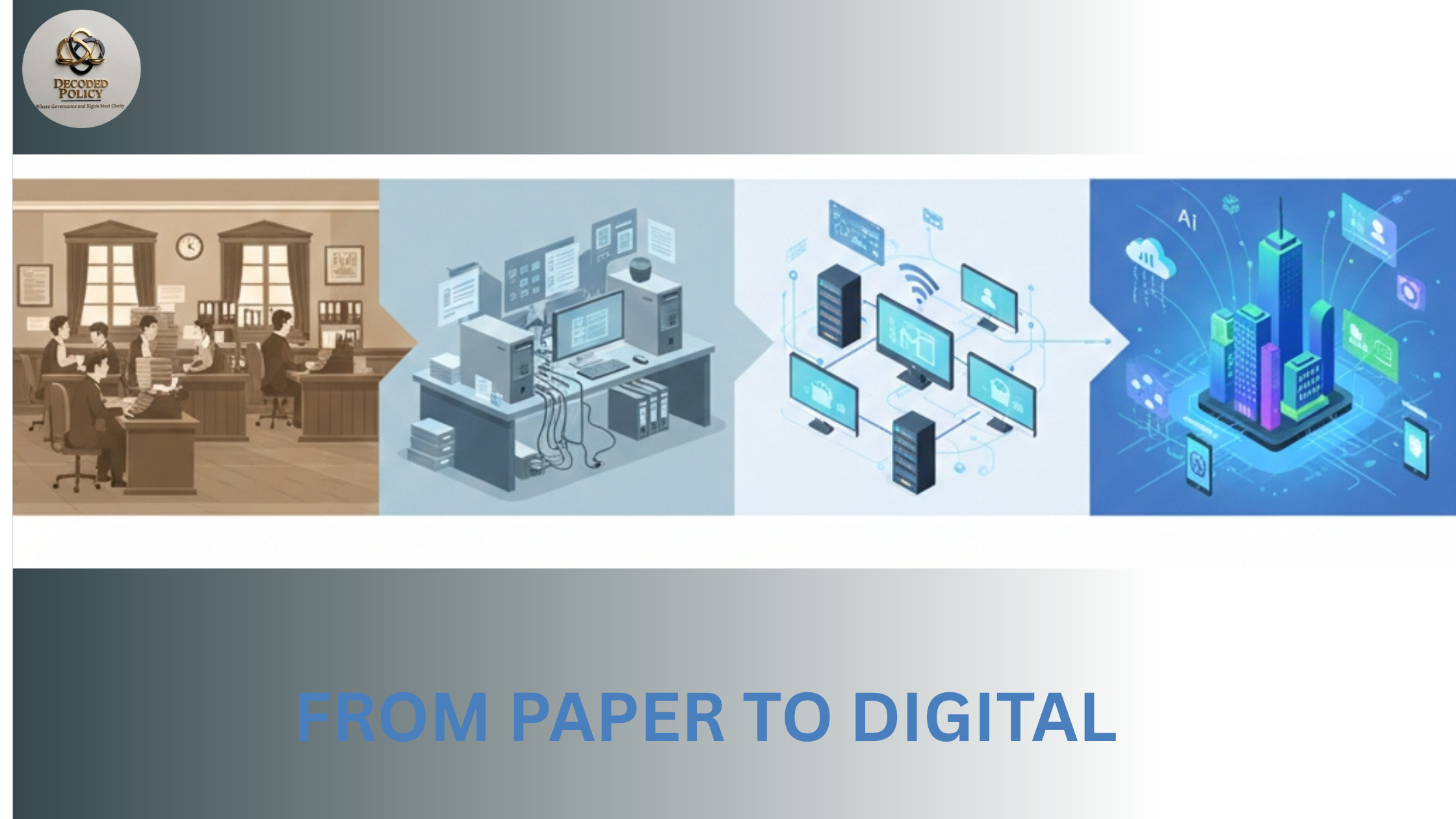
The evolution of e-governance began with traditional paper-based administration, where government work relied on manual processes.
During the era of computerization, records began to be digitized, and basic IT systems were introduced in offices. With the advent of the internet, online portals and e-services were developed, allowing citizens to access services from the comfort of their homes.
Today, e-governance provides faster and more citizen-centric governance through integrated digital platforms, mobile applications, and automation. This growth has transformed governance from a slow, manual system into a modern digital system.
Benefits of E-Governance
- Fast Service Delivery – Online systems make government services quick and time-saving, reducing delays for citizens.
- Transparency – Information is openly available on digital platforms, which helps reduce corruption and makes governance more transparent.
- Accountability – Online tracking and digital records ensure clear accountability of officials and maintain a proper record of decisions.
- Cost Efficiency – Reduced paperwork and manual processes lead to lower administrative costs and less resource wastage.
- Citizen Participation – Online feedback and grievance portals allow citizens to directly participate in the governance process.
- Accessibility – People in remote areas can also access services anytime, anywhere through digital platforms.
- Better Decision Making – Digital data and analytics enable the government to formulate data-driven policies.
- Reduced Corruption – Automated systems and minimal human intervention reduce the chances of bribery and manipulation.
Challenges in Implementation of E-Governance
- Digital Divide – The gap in internet access and digital literacy between rural and urban areas prevents everyone from receiving equal benefits.
- Cybersecurity Risks – Online systems are susceptible to data breaches, hacking, and privacy threats.
- Lack of Digital Literacy – Many citizens and officials lack proper training in using technology, which slows down adoption.
- Infrastructure Issues – Poor internet connectivity and a lack of adequate technical infrastructure make implementation difficult.
- Resistance to Change – Traditional mindsets and bureaucratic resistance create problems in accepting new digital systems.
- High Initial Cost – Setting up e-governance systems involves significant costs for software, hardware, and training.
- Data Privacy Concerns – Citizens fear that their personal data may be misused.
- Technical Failures – Server crashes, system errors, and software glitches can temporarily disrupt services.
Future of E-Governance
In the future, e-governance is going to become even smarter and more efficient with advanced digital technology. The future of e-governance will depend on policy innovations and emerging technologies. Governments are now moving beyond traditional online services to develop intelligent and citizen-centric governance systems.
- Artificial Intelligence (AI) – Automated services and smart policy decisions will become possible.
- Blockchain Security – Secure and tamper-proof digital records will increase transparency.
- Data Analytics – Real-time data will improve planning and governance outcomes.
- Cloud Governance – Fast and cost-effective digital infrastructure will be developed.
- Predictive Governance – Big data will enable early analysis of future challenges.
- Cyber Security Strengthening – Advanced security systems will build digital trust.
This transformation is likely to make governance more proactive, secure, and responsive.
E-Governance in India: Key Initiatives and Practical Examples
E-governance in India has witnessed rapid growth in the last decade, especially after the Digital India Initiative.
India has implemented multiple digital governance initiatives to support governance reforms, with the main focus on making public service delivery simpler and more accessible. Some of these initiatives are as follows:
- DigiLocker (Launched: 2015):- A digital document wallet where citizens can store and share their government documents online. According to Digital Locker reports, more than 50 crore users have registered so far, and billions of digital documents have been issued/verified.
- Direct Benefit Transfer – DBT (Launched: 2013):- Transfers government subsidies and benefits directly to bank accounts, reducing middlemen and leakage. According to the official DBT portal, more than ₹43.95 lakh crore has been transferred under multiple schemes.
- Aadhaar Enabled Services (Launched: Aadhaar 2009 / Services ~2012 onwards):- Provides easy access to banking, subsidies, and government services through biometric-based identity verification. According to official records, more than 142 crore Aadhaar IDs have been generated, and millions of authentications are being performed daily.
- BHIM UPI & Digital Payments (Launched: UPI 2016 / BHIM App 2016):- A mobile-based instant bank-to-bank digital payment system. According to official payment statistics, more than 20 billion transactions are processed monthly.
- MyGov Platform (Launched: 2014):- A citizen engagement platform where people participate in policy ideas, feedback, and governance discussions. According to official MyGov data, more than 3 crore users are connected to the platform.
- e-Courts Project (Launched: 2007):- Digitizes court cases, improving online case status, e-filing, and judicial transparency. According to official data, more than 14,000 courts have been computerized, and crores of cases are accessible online.
Global Examples of Successful E-Governance Practices
At the global level, some countries have developed advanced e-governance systems. The practical impact of governance is clearly understood from these models. Some of these countries and their initiatives are as follows:
| COUNTRY | E-GOVERNANCE INITIATIVES | EXPLANATION |
| Estonia | Digital Identity System | Every citizen receives a secure digital ID that allows them to access voting, banking, and almost all government services online — enabling fast and paperless governance. |
| Finland | Open Data Governance | The government keeps its data open to the public, increasing transparency and allowing researchers, developers, and citizens to use the data for innovation and analysis. |
| Denmark | Digital Mail System | Official communication between the government and citizens takes place entirely through digital mail — notices, updates, and documents are received online, saving both time and paper. |
Conclusion
E-governance has transformed traditional governance into a digital, transparent, and citizen-centric system. Indian initiatives like DigiLocker, DBT, and UPI have made public services faster and more accessible, while global models from countries like Estonia, Finland, and Denmark showcase advanced digital governance.
Along with the benefits, there are also challenges such as the digital divide and data security, which need to be addressed through strong policies and digital awareness. Overall, e-governance is a continuous process of making governance efficient, participatory, and future-ready.