Decentralization and Local Governance in India play a vital role in empowering citizens at the grassroots level. Decentralization is a fundamental principle of democratic governance. It refers to the transfer of power, authority, and responsibility from higher levels of government to lower or local levels of government. Decentralization simply means bringing governance closer to the people. Decentralization is considered an essential feature of modern governance because it distributes power from a centralized structure to local institutions.
In a large and diverse country like India, where local problems and needs vary in every region, the role of decentralization becomes very significant.
In India, decentralization is not just an administrative reform but also an important tool for democratic empowerment. After the 73rd and 74th constitutional amendments, local governments received constitutional status, which strengthened Panchayati Raj institutions and urban local bodies. In this context, decentralization and local government have become an important pillar of India’s governance framework.
Concept of Decentralization
Meaning of Decentralization
Decentralization means systematically transferring the processes, functions, and responsibilities of governance from a higher level of government to a lower or local level. When decisions are made at the local level, local problems can be better understood and solved. Through this process, decision-making authority is not limited to the central or state government, but elected local institutions are also empowered. The main objective of decentralization is to make governance more efficient, responsive, and people-centric.
Types of Decentralization
Different forms of decentralization and local governance in India: democratic, administrative, and fiscal, that ensure people’s participation and efficient service delivery.:
Democratic decentralization
Democratic decentralization and local governance in India strengthen citizen participation and accountability through elected local representatives. Democratic decentralization means transferring political power from the central or state government to elected local representatives. This gives people the right to choose their representatives through local elections. The main focus of democratic decentralization is on the democratic distribution of power, which grants elected local governments the authority to make quality decisions and plan for local development. Panchayati Raj institutions and urban local bodies are important examples of this type of decentralization. This type of decentralization increases direct citizen involvement, improves accountability and participatory decision-making, and promotes overall good governance.

Administrative Decentralization
Administrative decentralization refers to the transfer of administrative power and responsibilities from central and state levels to local government institutions. Its main focus is on the implementation aspect of government. In this process, local bodies are given authority related to planning, implementation, and execution, allowing policies to be effectively implemented at the grassroots level. This makes local institutions more responsive and capable of making decisions according to local needs.

Fiscal Decentralization
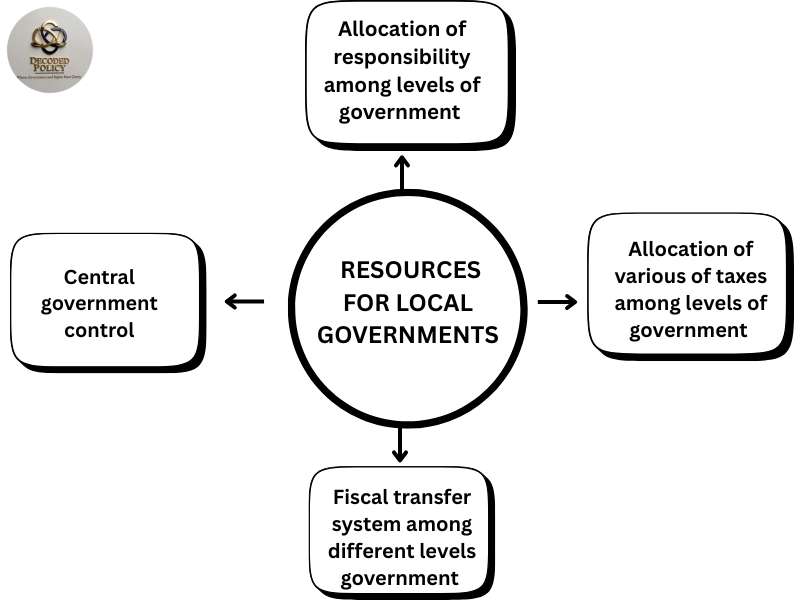
Physical decentralization means transferring financial power and resources from the central or state government to local bodies. This gives local bodies the power to plan their own budgets, collect taxes and fees, and spend on development work. This makes local government more effective. When local governments have adequate funds and spending power, decentralization is enhanced, and good governance is supported.
Evolution of Local Governance in India
The roots of decentralization and local governance in India can be traced from ancient village institutions to modern constitutional reforms.
Local Governance in Ancient and Medieval India
In ancient India, the system of local government was quite strong. The roots of local government in ancient India can be traced back to the Vedic period. The Rig Vedic and later Vedic texts mention institutions like ‘Sabha’ and ‘Samiti,’ which functioned as decision-making bodies at the local level.
Kautilya’s Arthashastra also provides a detailed description of local administration. According to it, villages were self-governing units where the ‘Gramika’ (village head) was responsible for local administration, tax collection, and maintaining law and order. Despite the existence of a strong centralized empire during the Mauryan period, the system of local governance was quite developed. This indicates that governance in ancient India was based on a balance between centralized power and local autonomy.
In medieval India, despite the presence of strong central rule, the tradition of local governance continued. Village communities managed their own internal affairs, such as law enforcement, irrigation, and dispute resolution. During the Delhi Sultanate, the IQTA system existed, in which land revenue administration was managed through local officials. The system of local governance remained quite strong during the Mughal period as well. Sources like the Ain-i-Akbari indicate that villages functioned as autonomous units. According to historians, village councils acted as informal local bodies, reflecting the continuity of decentralized governance.
Local Governance during British Rule
During British rule, local governance in India was given a formal institutional form, but its main purpose was not democratic empowerment but rather administrative efficiency and revenue collection. The colonial government developed local-level institutions to streamline its governance.
The most important step during this period was Lord Ripon’s Resolution of 1882, which is considered the foundation of local self-government in India. It introduced the idea of elected local bodies and limited autonomy, but real power still remained with British officials.
Local institutions were established through Municipal Acts, District Boards, and Local Boards, whose functions were limited to sanitation, roads, and tax collection. Despite the limitations, these bodies laid the groundwork for the local governance framework of independent India.
Constitutional Framework of Decentralization in India
In India, decentralization has been strengthened not only at the policy level, but also with constitutional backing. The Constitution recognizes local self-governance as an important part of the democratic system and provides clear provisions for it. Local governance has received institutional support through the Directive Principles and Constitutional Amendments.
Directive Principles and Local Governance
Article 40 of Part IV of the Indian Constitution, which deals with the Directive Principles of State Policy, directs the state to organize village panchayats and endow them with the necessary powers for self-government. Its objective is to bring governance closer to the people and encourage participatory decision-making at the village level. Article 40 clearly indicates that democracy should not be limited to elections but should reach the grassroots level. This principle later provided the ideological basis for the Panchayati Raj reforms. Within the constitutional framework of decentralization, Article 40 reflects a moral commitment.
73rd Constitutional Amendment Act, 1992
The 73rd Constitutional Amendment Act of 1992 is regarded as a pivotal moment in India’s decentralization process. This amendment granted constitutional status to Panchayati Raj institutions and provided an institutional framework for rural local self-government. The primary objective of this amendment was to strengthen grassroots democracy.
Provisions such as a three-tier structure, regular elections, reservation for women and marginalized groups, and the establishment of a State Finance Commission are core features of this amendment. The Gram Sabha was given a central position, creating scope for improved transparency and accountability. Through the 11th Schedule, Panchayats were mandated to work on development-related subjects. This amendment transformed decentralization into a constitutional reality.
74th Constitutional Amendment Act, 1992
The 74th Constitutional Amendment Act of 1992 granted constitutional recognition to urban local bodies and included urban governance within the framework of decentralization. The objective of this amendment was to make the governance of cities more responsive and accountable.
Through this amendment, the election, tenure, reservation of seats, and functional responsibilities of municipalities were clearly defined. It attempted to make local urban governments an integral part of the decision-making process. The 12th Schedule assigned subjects such as urban planning, public services, and infrastructure development to the municipalities. This amendment establishes a uniform national framework for urban local governments, thereby strengthening decentralization.
Structure of Local Governance in India
The structure of decentralization and local governance in India includes both rural and urban local bodies working at different administrative levels. In India, the structure of local governance is organized through different institutions for rural and urban areas. This structure provides a practical framework for implementing decentralization at the grassroots level. Panchayati Raj Institutions and Urban Local Bodies bring governance closer to the citizens.
Panchayati Raj Institutions (Rural)
The core of rural local governance is the Panchayati Raj Institutions, which function with constitutional status after the 73rd constitutional amendment. Their three-tier structure is as follows:
Gram Panchayat (village level) – This is the basic governing body at the village level, which works on local development, sanitation, water supply, and the implementation of government schemes. Its main role is to implement the decisions of the Gram Sabha.
Panchayat Samiti (block level) – This body coordinates the work of the Gram Panchayats at the block level and plans and monitors development programs. It acts as a linking body between the village and district levels.
Zila Parishad (district level) – This is the highest rural local body at the district level, which undertakes overall rural development planning and supervision. It implements district-level policies and schemes in coordination with the state government.
Rural local bodies are a practical example of decentralization where elected representatives directly address the issues of local communities. Through reservation provisions, women and marginalized groups get representation in governance, which promotes inclusive development.
Urban Local Bodies
Urban local governance functions through urban local bodies, which received constitutional status after the 74th Constitutional Amendment. This system includes municipal corporations, municipal councils, and Nagar Panchayats, which operate based on the size and population of the city.
Municipal Corporation – This is for large cities and handles major civic functions such as urban planning, water supply, sanitation, transport, and infrastructure development. Its administrative structure is more robust.
Municipal Council (Municipality) – This is for medium-sized towns and manages basic urban services such as roads, street lighting, waste management, and local markets. It is comparatively smaller than a municipal corporation.
Nagar Panchayat – This is for transitional areas that are moving from rural to urban. Its role is to provide basic civic services and develop a gradual urban governance system.
Urban local bodies implement decentralization in the urban context. Governance through elected representatives at the local level makes urban administration more responsive and accountable.
Role of Local Governance in Decentralized Democracy
- Local governance makes citizens a direct part of the decision-making process, thereby strengthening democracy at the grassroots level.
- Panchayati Raj Institutions and Urban Local Bodies help in formulating policies and development plans according to local needs.
- Local governance improves transparency and accountability because elected representatives are directly responsible to the people.
- This system provides representation in governance to marginalized sections, such as women and weaker groups.
- Decentralized democracy makes service delivery more effective and people-centric.
Achievements of Decentralization in India
- Through decentralization, political participation at the grassroots level has increased significantly.
- The representation of women and Scheduled Castes and Scheduled Tribes in local governance has improved considerably.
- Local planning and development have become more need-based and region-specific.
- Public awareness and participation have increased through Gram Sabhas and local meetings.
- Some states, such as Kerala, have seen positive results from decentralized planning.
Challenges in Decentralization and Local Governance
Political Challenges
- Elite capture in local governance is a major political challenge, where power remains concentrated in the hands of a few influential individuals.
- State governments often hesitate to fully empower local bodies.
- Political interference restricts local decision-making and autonomy.
- The politicization of local elections dilutes the primary objectives of governance.
Administrative Challenges
- Local bodies often lack trained staff and administrative expertise.
- Bureaucratic dominance limits the authority of locally elected representatives.
- A lack of coordination between planning and implementation impacts effective governance.
- Weak monitoring and evaluation mechanisms affect service delivery.
Financial Challenges
- Local bodies have limited independent revenue sources.
- The recommendations of the State Finance Commission are not properly implemented.
- Over-reliance on grants and funds restricts local financial autonomy.
- Inadequate funding directly affects local development projects and public services.
Role of Technology in Strengthening Local Governance
- Technology has enhanced transparency in local governance by making information related to budgets, schemes, and development projects available through online portals.
- E-governance systems have improved service delivery by allowing citizens to apply online for certificates, licenses, and welfare benefits, reducing delays and middlemen.
- Digital grievance redressal platforms enable citizens to directly report local issues and track their complaints, which increases accountability of local authorities.
- Direct Benefit Transfer (DBT) ensures that welfare funds reach beneficiaries directly in their bank accounts, minimizing corruption and financial leakages.
- Geographic Information System (GIS) and digital data systems help local bodies in better planning and monitoring of infrastructure, sanitation, and public services.
Way Forward
The way forward for strengthening decentralization and local governance in India lies in ensuring real devolution of powers, functions, and finances to local bodies as envisioned under the 73rd and 74th Constitutional Amendments. Local governments must be provided with adequate financial resources and greater administrative autonomy to function effectively. Regular capacity-building and training of elected representatives, along with increased use of technology, e-governance, and data-based planning, can significantly improve transparency and accountability. At the same time, active citizen participation, social audits, and stronger coordination between state governments and local institutions are essential to promote inclusive development and achieve the broader goals of good governance.
Conclusion
Decentralization and local governance play a crucial role in bringing democracy closer to the people. By empowering local bodies, citizens get a direct voice in decision-making, which improves accountability, participation, and service delivery at the grassroots level. Although India has made significant progress through constitutional reforms and local institutions, challenges related to finance, administration, and political interference still remain. Addressing these issues through stronger devolution, capacity building, and the use of technology can help local governments function more effectively. Ultimately, strong local governance is essential for inclusive development and the achievement of good governance in India. Overall, decentralization and local governance in India remain essential for inclusive development and the promotion of good governance.