Introduction: Understanding Public-Private Partnership (PPP) Governance
When the government has limited resources but development needs are growing rapidly, then a public-private partnership emerges as an effective solution.
Public-Private Partnership (PPP) is a collaborative governance framework where the public and private sectors jointly deliver infrastructure projects and essential public services. It not only involves funding share but also risk sharing, accountability mechanisms, and performance monitoring.
Today, the role of Public-Private Partnership (PPP) is clearly visible in many projects like highways, airports, metro projects, smart cities, etc. But its success depends on the regulatory framework and transparent monitoring.
Therefore, understanding Public-Private Partnership (PPP) governance is important not only theoretically but also in practice.
What is Public-Private Partnership (PPP)? Concept, Meaning & Governance Perspective
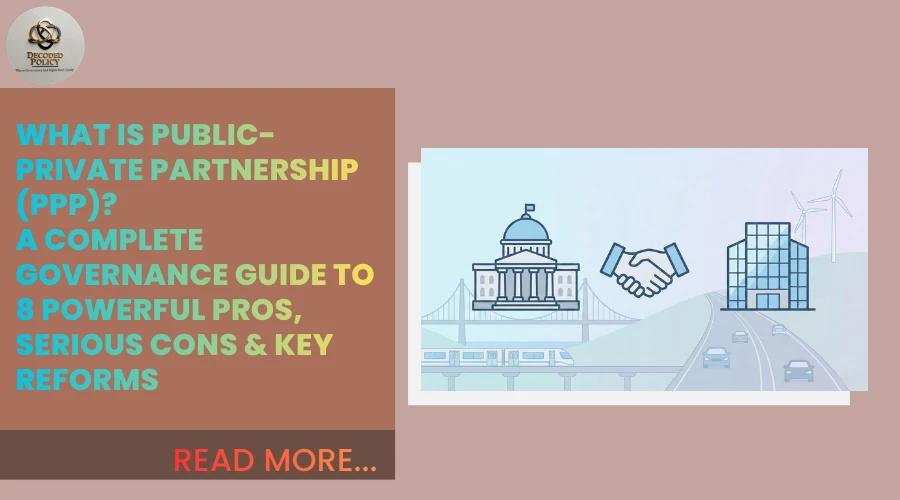
Public-Private Partnership (PPP) is an institutional arrangement where the government and the private sector execute public projects together through a formal agreement. Its main objective is to ensure efficient infrastructure development and public service delivery.
It would be wrong to consider Public-Private Partnership (PPP) as just a financial arrangement. Conceptually, it is a governance mechanism where a public authority and a private entity work together with predefined roles.
In this model, the government plays a regulatory and supervisory role, while the private sector provides operational efficiency and technical expertise.
From a governance perspective, Public-Private Partnership (PPP) provides a structured framework to balance accountability, transparency, and public interest.
This model is especially used in sectors that require large-scale investment and professional management. Nowadays, the Public-Private Partnership (PPP) model has become quite common in highways, airports, smart cities, and healthcare projects.
Evolution of PPP Governance: From Traditional Public Service to Collaborative Governance
Initially, public services were completely under the control of the government, like building roads, running hospitals, or managing power supply.
This was the traditional public service model, but with time, the problems became complex, and public policy demands started growing rapidly. Due to limited funds and administrative capacity with the government, the government felt the need for alternative governance models, and from here the evolution of PPP governance started.
After the 1990s, the trend of liberalization and decentralization promoted collaborative governance. In this background, PPP governance developed – a model where the government and the private sector together share responsibilities.
This shift was not just a management change but a transformation of governance philosophy – from control to collaboration. Today, PPP governance is not just limited to infrastructure but has become an important tool for good governance, accountability, and performance management. Digital monitoring and e-governance tools have also made the PPP framework more transparent and result-oriented.
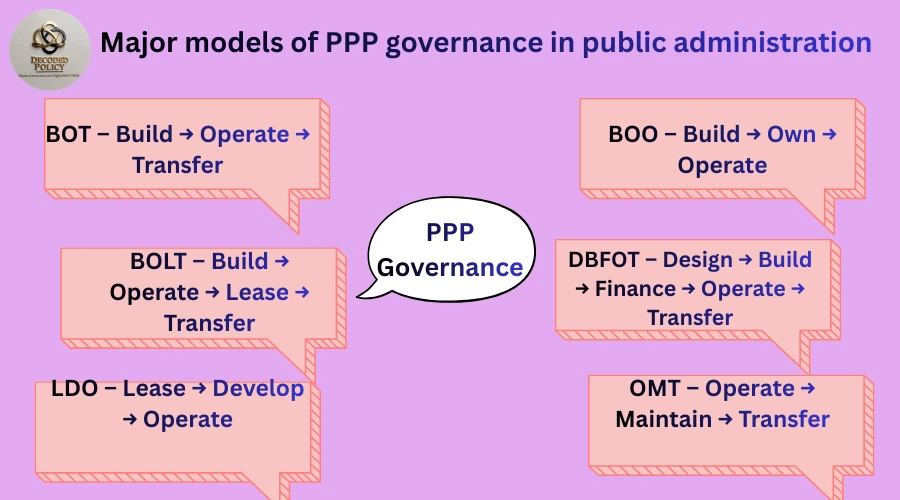
Major Models of PPP Governance in Public Administration
To effectively implement PPP governance in public administration, different operational models are used. Each model has slightly different structures, risk-sharing patterns, and public policy objectives, which impact good governance outcomes.
- Build-Operate-Transfer (BOT)- In this model, a private company builds the project, operates it for a few years, recovers the investment, and then transfers the asset to the government. This model is quite common in the infrastructure sector.
- Example: The Delhi-Gurgaon Expressway was developed using the
- BOT model.BOO (Build-Own-Operate)- In this model, a private entity builds, owns, and operates the asset. The government ensures accountability through a regulatory framework.
- Example: Some private power plants operate on the BOO model.
- Build-Operate-Lease-Transfer (BOLT)- In this model, a private partner develops the project and leases it to the government. The asset is transferred after the lease period. This helps reduce fiscal burden under public policy.
- Example: Some police housing projects have been developed on the BOLT model.
- Design-Build-Finance-Operate-Transfer (DBFOT)- In this model, the private sector handles everything from design to finance and operation. E-governance monitoring systems are used for transparency.
- Example: Some segments of the Mumbai-Pune Expressway were developed on the DBFOT structure.
- Lease-Develop-Operate (LDO)- A private partner leases an existing public asset, modernizes it, and operates it.
- Example: Mumbai Airport modernization is a practical case of the LDO arrangement.
- Operate-Maintain-Transfer (OMT)- Private companies handle only operation and maintenance, while ownership remains with the government.
- Example: Many toll roads on National Highways operate on the OMT model.
Powerful Advantages of PPP Governance in Public Service Delivery
- Reduced Fiscal Burden- Government’s upfront capital expenditure has reduced, thereby reducing budgetary pressure.
- Efficient Service Delivery- PPP governance makes services more efficient through public and private collaboration.
- Faster Development Projects- Infrastructure projects are completed comparatively sooner, which improves public policy outcomes.
- Long-Term Sustainability- Structured contracts ensure long-term infrastructure sustainability and maintenance.
- Improved Transparency- Performance-based contracts support monitoring and good governance.
- Resource Mobilization- This model supports achieving public policy goals by attracting private investment.
- Cost Efficiency- PPP governance helps in delivering public services at relatively lower cost through operational efficiency.
- Technological Integration- Use of modern technology and e-governance systems in PPP projects improves transparency and monitoring.
Serious Cons & Hidden Risks in PPP Governance
- High Long-Term Costs- Sometimes, PPP projects seem affordable in the short term, but they become more costly for the government in the long term.
- Risk of Monopoly- Excessive control given to the private partner can lead to the development of monopoly tendencies in the service sector.
- Public Interest vs Profit Conflict- The profit motive of the private sector can sometimes conflict with public policy objectives.
- Unequal Risk Distribution- In some cases, the actual risk remains with the government, which does not reduce the fiscal burden.
- Renegotiation Risks- Many PPP contracts are later renegotiated, which impacts transparency and public trust.
- Overdependence on the Private Sector- Excessive reliance can weaken the internal capacity of public administration.
Key Challenges in Implementing PPP Governance Effectively
- Transparency Concerns- If project details are not shared openly, good governance is weakened.
- Weak Regulatory Framework- If the regulatory system is not strong, it becomes difficult to ensure good governance and accountability.
- Institutional Capacity Gap- Many government departments do not have adequate administrative capacity to design and monitor Public-Private Partnership (PPP) projects.
- Decentralization Barriers- Shortage of technical expertise and financial planning skills with local governments slows down implementation.
- Risk Allocation Imbalance- If risk-sharing is not clearly defined, disputes and governance conflicts can arise.
Real-World Examples of PPP Governance (India & Global Case Studies)
To understand PPP governance, it is important to look at real-world case studies, as this provides insight into how public policy and good governance principles are implemented at the ground level.
India Case Studies
- Delhi International Airport (LDO Model) – The Delhi Airport modernization project was implemented on PPP mode through a GMR-led consortium, increasing passenger capacity from around 16 million in 2006 to 79+ million annually. This project is considered a strong example of operational efficiency and the integration of digital governance systems.
- Hyderabad Metro Rail (DBFOT Model) – This project, worth approximately ₹20,000+ crore, is one of the largest metro PPP projects in the world. It strengthened urban decentralization and smart city development, but also faced initial financial restructuring challenges.
- Gujarat Solar Park (PPP Structure) – Charanka Solar Park is an example of a Public-Private Partnership (PPP) collaboration where renewable energy capacity expanded to 600+ MW. This is considered an SDG-aligned public policy initiative.
Global Case Studies
- United Kingdom – Private Finance Initiative (PFI) – The UK adopted the PFI model in the 1990s, implementing over 700 projects, including hospitals and schools. A debate arose over transparency and the long-term fiscal burden, which triggered governance reforms.
- Chile – Highway PPP Program – Chile implemented large-scale highway Public-Private Partnership (PPP) projects since the 1990s, modernizing transport infrastructure and accelerating economic growth. A strong regulatory framework helped maintain transparency.
Key Reforms Needed to Strengthen PPP Governance
- Strong regulatory framework
- Transparent bidding & contract design
- Risk-sharing clarity in public policy
- Independent monitoring authority
- Digital governance based project tracking
- Fiscal accountability and audit reforms
Future of PPP Governance: Digital Governance, AI & Sustainable Development Goals
The direction of PPP governance in the future is clear—without digital governance and sustainability, this model will not be successful in the long term. Simply attracting private investment will not be enough; technology-driven transparency will be essential.
AI algorithms can make project feasibility analysis, cost estimation, and performance benchmarking accurate. Digital tools like blockchain can improve transparency and contract security, which are essential for good governance. The PPP model can become the backbone of digital infrastructure development in Smart Cities initiatives.
PPP can become a strategic instrument for achieving Sustainable Development Goals targets such as climate action and inclusive growth. But building the digital capacity of local authorities through decentralization will be equally important; the digital divide could create a governance gap.
Conclusion: PPP Governance as a Tool for Good Governance & Sustainable Public Policy
In today’s complex governance environment, Public-Private Partnership (PPP) governance has emerged as a strategic tool that can accelerate both development and service delivery. But its true value is realized only when it aligns with the core principles of good governance.
Strong public policy design, transparent contracting, and digital monitoring systems can make PPP projects accountable and citizen-centric. If decentralization and stakeholder participation are seriously integrated, Public-Private Partnership (PPP) governance can become an engine of inclusive growth.
Ultimately, Public-Private Partnership (PPP) is neither a complete solution nor an inherent problem—it is a governance choice. Policy clarity, ethical standards, and e-governance integration will be the most important pillars to make this choice sustainable.