Meaning & Scope of Public Policy
Meaning:
Public policy is a set of laws, rules, regulations, government directives, or funding decision-making procedures that governments or their representatives make to protect the public interest and solve societal problems.
Its purpose is to make governance systematic and to address public needs such as education, health, the economy, and security optimally. Strong public policy promotes development and maintains fairness and stability in society.
Scope:
The scope of public policy is very wide, as it covers almost every important sector of society. It includes areas such as education, health, the economy, the environment, law and order, and social welfare.
Policies are implemented at the local, national, or international level. Government agencies, the private sector, and civil society all play a role in this.
It starts with problem identification and completes the entire process from policy making to implementation and evaluation, hence the impact of public policy is directly on public life. Overall, its scope is linked to the development of society and governance improvement.
Definitions of public policy by different people
B. Guy Peters has defined public policy as “the set of activities that governments engage in for the purpose of changing their economy and society.”
John W. Kingdom has defined public policy as “public policy is what the government chooses to do or not to do. Decision makers do not choose from an unlimited set of policy alternatives; rather, they select from a smaller set of policy options that are on the agenda.”
Thomas R. Dey has defined public policy as ” public policy is whatever governments choose to do or not to do.”
Importance of Public Policy in Governance
- Public policy is the basis of effective decision-making and public service delivery. It gives direction to governance and makes government actions systematic.
- It helps in solving public problems and ensures fair distribution of resources.
- It clarifies government priorities and helps in long-term planning. Strong policy accelerates development and increases public trust.
- It strengthens public participation and democratic values.
- It supports social justice and equality, which benefits the weaker sections.
- It also plays an important role in maintaining stability and law and order in society.
- A strong policy framework reduces corruption and administrative inefficiency, leading to good governance.
- Effective public policy improves sustainable development and global competitiveness.
6 Main Types of Public Policy
Public policy is generally divided into six types, which are as follows:
- Substantive Policy –Substantive public policy is a policy that directly solves public problems and improves people’s lives. Its focus is on real welfare outcomes.
Examples: Health reform in 2017, Free education scheme, Public health care program, etc.
- Regulatory Policy –Regulatory public policy is a policy that controls the behavior of people, companies, and institutions by establishing rules and laws that aim to maintain safety, fairness, and order.
Examples: Traffic rules, Pollution control laws, Labour laws, Food safety laws, etc.
- Distributive Policy –Distributive public policies are policies that allocate resources and benefits to different regions or groups without causing direct loss.
Examples: Road construction, Rural infrastructure, Water supply scheme, Local hospital construction, etc.
- Redistributive Policy –Redistributive policies are those that reduce inequality by shifting income and resources from one group to another, supporting weaker sections and promoting equal opportunities.
Examples: Free ration schemes, Subsidies, Pension schemes, Unemployment benefits, etc.
- Constituent Policy –Constituent public policies are for policies that define the framework, structure, and institutions of the government. It organizes the basic rules and administrative setup for the functioning of the government.
Examples: Decentralization reform, Constitutional Amendments, Election commission reform, etc.
- Capitalisation Policy –Capitalization is a public policy that promotes economic growth or infrastructure development through government investment or financial support. Its focus is to build long-term assets or institutional capacity.
Examples: Smart city project, Digital infrastructure for e-governance, Public sector investment, etc.
Policy Cycle: Policy Making vs Policy Implementation
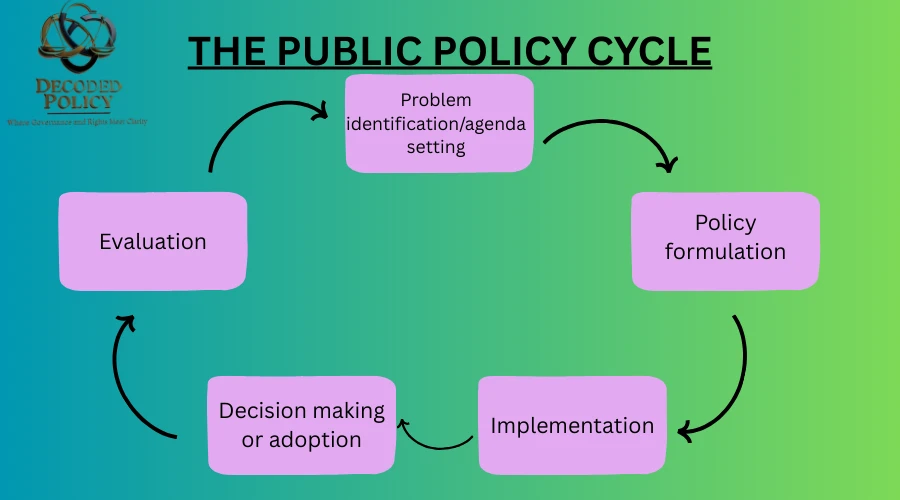
The policy cycle is a continuous, step-by-step process through which governments identify public problems and develop solutions. Some of its key steps are as follows:
- Problem identification/agenda setting: Public issues are identified (such as health, education, governance problems, etc.).
- Policy formulation: Experts or the government work together to design solutions.
- Decision making or adoption: The policy is approved and becomes official.
- Implementation: The bureaucracy and the governance system implement the policy on the ground.
- Evaluation: The policy’s results are examined to determine whether the policy is effective or needs change. This process gives practical shape to good governance.
Key Actors: Government vs Bureaucracy vs Civil Society
Public policy is a collaborative process where three key actors play a role in the formulation and implementation of public policy: government, bureaucracy, and civil society. Coordination among these three is essential for good governance and effective policy outcomes.
The roles of the three key actors in public policy formulation and implementation are as follows:
- Government: Government includes elected leaders, ministers, parliament/legislature, and key policy decision-making authorities. Its main role is to set the vision, decide national priorities and reforms, pass laws, and take final policy decisions.
- Bureaucracy: Bureaucracy includes civil servants, administrative officers, government departments, and implementation agencies. Their main role is to provide administrative expertise, ensure execution, and coordinate ground-level implementation and decentralisation.
- Civil society: Civil Society includes NGOs, media, community groups, activists, and ordinary citizens. Their role is to provide public feedback, raise awareness, and ensure accountability, which ultimately promotes good governance.
Major Challenges in Public Policy (Design vs Implementation Issues)
Many challenges arise from formulating public policy to implementing it on the ground. Some problems arise at the policy design stage, while others occur during the implementation phase, affecting good governance outcomes.
Issues during policy design:
- Unclear Goals & Vague Policy Framework – When objectives are not clear, both implementation and evaluation become weak.
- Poor Data & Weak Research Base – Due to a lack of accurate data and stakeholder consultation, policies have become disconnected from ground reality.
- Political Pressure & Unrealistic Promises – Short-term political goals prevent policy design from being practical and sustainable.
- Ignoring Ground Realities – Policies have failed at the practical level by ignoring local needs and decentralization factors.
- Weak Risk & Social Impact Assessment – Not having a proper analysis of potential risks and social consequences has led to unexpected problems.
- Poor Planning & Resource Mismatch – Weak long-term planning and budget alignment lead to delays and inefficiencies in policy execution.
Issues during implementation:
- Bureaucratic Delays & Administrative Inefficiency – Slow decision-making and complex procedures delay policy execution.
- Lack of Funds & Resource Constraints – Policies cannot be properly implemented due to a lack of adequate budget, staff, and infrastructure.
- Poor Coordination Between Agencies – Weak coordination between the government, bureaucracy, and decentralization bodies slows down execution.
- Weak Monitoring & Accountability Systems – Without proper tracking and evaluation, it becomes difficult to measure policy outcomes.
- Limited Capacity & Training at Ground Level – Service delivery has become weak due to a lack of skill and training of local staff.
- Low Public Awareness & Citizen Participation – Due to low civil society involvement, the real impact and adoption of policies are reduced.
Powerful Solutions (Policy Reforms vs Innovation & Technology)
Solving public policy challenges requires a balance between traditional reform and modern technology. In modern governance, policy reform strengthens the structure, while technology makes execution smarter. Together, they create transparent, accountable, and citizen-centric policies.
Policy Reforms
- Clear & Evidence-Based Policy Design – Reforms based on data, research and stakeholder consultation make policies practical and result-oriented.
- Administrative & Institutional Strengthening – Transparent procedures and accountability systems strengthen good governance.
- Decentralization & Local Governance Reforms – Giving power to local authorities makes ground-level decision making fast and effective.
- Simplification of Rules & Procedures – Simplifying complex regulations reduces bureaucratic delays and improves service delivery.
- Performance-Based Monitoring & Evaluation – Regular review systems make timely improvements possible by measuring policy outcomes.
Innovation & Technology
- E-Governance Platforms – Digital portals and online services make policy implementation fast, transparent and citizen-friendly.
- Data Analytics & Evidence-Based Decisions – Real-time data makes policy planning and governance outcomes more accurate.
- Digital Monitoring Dashboards – Automated tracking systems improve policy performance and accountability.
- Online Grievance Redressal Systems – Provides a platform to give direct feedback to citizens which improves governance transparency.
- Automation & Smart Digital Infrastructure – Technology-based workflows strengthen administrative efficiency and public service delivery.
Real-World Examples (Successful vs Failed Public Policies)
| Successful Public Policy | Explanation with Data / Impact | Failed / Less Successful Public Policy | Explanation / Issues |
| Pradhan Mantri Jan Dhan Yojana (PMJDY) | The aim of Pradhan Mantri Jan Dhan Yojana (2014) was financial inclusion – to provide a basic bank account to every household. According to Ministry of Finance data, 57.52+ crore accounts were opened and ₹2.88 lakh crore+ deposits were reported, with rural and women beneficiaries having a large share. PMJDY strengthened DBT, subsidy transfer and e-governance delivery, thereby reducing leakages and improving good governance. Zero-balance account, RuPay card and insurance cover are its key features. | United States – Alcohol Prohibition (18th Amendment) 1920–1933 | The aim of Alcohol Prohibition was to reduce crime and improve social discipline by banning alcohol production and sale. But this significantly increased the illegal alcohol trade and organized crime and also increased enforcement costs. Due to public dissatisfaction and policy failure, prohibition was repealed in 1933 by passing the 21st Amendment. This example shows that policy objectives are not achieved by ignoring ground reality. |
| Goods and Services Tax (GST) Reform | GST was launched in July 2017 as a “One Nation One Tax” indirect tax reform. According to PIB highlights, “₹22.08 lakh crore gross GST collection” was recorded in FY 2024–25 (≈9.4% growth), and “1.51 crore+ active taxpayers” are registered in the system, which has strengthened compliance and formal economy. Digital filing and e-way bill system have made tax tracking efficient and reduced inter-state trade barriers. This reform is considered a major example of fiscal governance and cooperative federalism. | India – Three Farm Laws (2020 Agricultural Reform Laws) | The aim of the three farm laws was to bring about agricultural marketing reforms, attract private investment, and provide farmers with open market access. However, lakhs of farmers participated in nationwide protests, and strong political opposition was witnessed. Even after multiple negotiation rounds, consensus could not be reached. Finally, in November 2021, the government repealed these laws in Parliament, highlighting the importance of stakeholder consultation. |
| Unified Payments Interface (UPI) Initiative | The National Payments Corporation of India (NPCI) launched UPI in 2016 as a real-time digital payment system. According to NPCI data, UPI achieved a record 21.70 billion transactions and ₹28.33 lakh crore transaction value in January 2026, showing a 28% YoY growth in volume. The daily average was 700 million transactions and ₹91,403 crore value, reflecting the strong growth of digital payments adoption and financial transparency in India. | United Kingdom – Community Charge (“Poll Tax”) 1989–1991 | The United Kingdom’s Community Charge (Poll Tax) was introduced with the aim of simplifying the local government funding system and introducing a uniform tax structure. However, large-scale protests and riots in 1990 saw millions of people refuse to pay the tax. Following strong public opposition and political pressure, the government abolished the policy in 1991. Social inequality concerns and lack of public acceptance proved the policy politically unsustainable. |
Future Trends in Global Public Policy
Global public policy is changing rapidly due to technology, climate challenges and increasing citizen expectations. Future governance models will focus on a more digital, sustainable and participatory approach.
- Digital Governance & AI Policy Making – AI, big data, and e-governance tools will make faster decision-making, real-time monitoring, and efficient public service delivery possible.
- Sustainable Development & Climate Governance – Climate policies, green energy, and sustainable urban planning will remain the core focus of future global governance.
- Participatory Governance & Decentralization – Citizen participation, local governance, and digital feedback systems will make policies more inclusive and ground-reality based.
Conclusion: Key Lessons & Way Forward
Effective public policy strengthens good governance and ensures that initiatives like the New Health Policy 2017 reach citizens efficiently.
Digital tools and e-governance platforms make policy implementation transparent, accountable, and citizen-centric. Decentralisation empowers local authorities to take faster, ground-level decisions, improving service delivery.
Learning from successes like PMJDY and innovations in UPI shows that evidence-based reforms drive sustainable development.
Moving forward, integrating technology, participatory governance, and strong policy frameworks will make global governance more inclusive, efficient, and impactful.