Introduction: Understanding the Concept of Government
What is government? It is one of the most fundamental questions in political science and public administration. Every society needs an organized system to function smoothly, and this system is known as government. In the modern world, it acts as the central decision-making authority that maintains order and stability.
Government is a structured network of institutions and leaders responsible for making laws, implementing policies, and delivering essential public services. Through these functions, the system ensures that citizens’ needs are addressed and development takes place in a planned manner.
The primary aim of government is to maintain social order, protect the rights of people, and promote economic and social progress. At the same time, it also focuses on transparency, accountability, and effective governance to improve the overall quality of life.
Understanding ‘what is government?’ is essential, as it forms the foundation of governance, public policy, and administrative systems in any country.
What Is Government? Meaning, Definition and Governance Perspective
What Is Government? Meaning, Definition
In simple terms, what is government? It can be understood as the system that governs and manages a country. Simply put, a Government is an organized authority responsible for the management of a country or society.
This system enacts laws, implements policies, and provides public services to ensure that society functions smoothly.
Its primary objectives are to maintain social order, protect citizens’ rights, and safeguard national development.
Governance Perspective
From the perspective of governance, the role of the government is not limited solely to administrative functions; rather, transparency, accountability, and citizen participation are equally vital aspects of its role. For this reason, the government is considered the central pillar of public administration.
Why Government Is Important in Modern Society
In modern society, the role of the government is extremely important because it maintains social order and stability.
Every society comprises diverse interests, beliefs, and conflicts, and the government manages them through laws and regulations. Without the rule of law, chaos, crime, and disorder can increase within society.
Furthermore, the government provides essential public services such as education, healthcare, sanitation, and infrastructure development. These services directly improve the quality of life for citizens and contribute to balanced growth.
In today’s globalized and rapidly changing world, the importance of government has increased even further. It is no longer limited to administration alone; rather, it has become the central pillar of governance, handling everything from policy-making and implementation to monitoring and evaluation.
In times of crisis—such as pandemics, natural disasters, or economic recessions—the government’s role becomes even more critical.
From a governance perspective, the government promotes transparency, accountability, and citizen participation. Moreover, through digital governance and e-governance, decision-making processes are becoming faster, more efficient, and more accessible.
When viewed from a real-world perspective, the significance of government becomes even clearer.
During the pandemic, the government imposed lockdowns, strengthened the healthcare system, and conducted vaccination drives.
Had the government not taken these crucial decisions, the situation could have gone completely out of control. This clearly demonstrates how important government intervention is during emergency situations.
Similarly, global conflicts—such as tensions between Iran and the USA—directly affect oil prices, making petrol and diesel more expensive.
For an oil-import-dependent country like India, this creates serious challenges. In such situations, India’s foreign policy plays a vital role. The government maintains strategic international relations, diversifies oil imports from regions such as the Middle East and Russia, and works to ensure energy security through global diplomacy.
At the same time, at the domestic level, the government tries to reduce the economic burden on citizens through measures such as tax control, subsidies, and the promotion of alternative energy sources. This example shows that the government not only maintains economic stability but also balances national interests and public welfare through effective foreign policy.
Therefore, a strong, responsive, and accountable government is essential for the smooth functioning and long-term development of modern society.
Key Functions of Government in Public Administration
After understanding ‘what is government?’, let us now understand some key functions of government.
- Delivery of Public Services- The government provides essential services such as education, healthcare, transport, sanitation, etc., which directly impact the daily lives of citizens.
- Lawmaking (Legislative Function)-The government enacts laws and regulations to maintain order in society and protect the rights of citizens.
- Policy Formulation and Implementation- The government formulates policies for various sectors (education, health, and economy) and implements them effectively.
- Maintenance of Law and Order- The government maintains internal security and peace through the police and administrative system.
- Revenue Collection and Budgeting- The government collects taxes and allocates that revenue to development projects and welfare schemes.
- Welfare and Social Justice- The government supports vulnerable groups and promotes equality through schemes and programs.
- Economic Planning and Development- The government plans for economic growth, generates employment, and develops infrastructure.
- Judicial and Dispute Resolution Function- Through courts, the government ensures justice and resolves disputes.
- Crisis Management and National Security- The government ensures the safety of citizens by making decisions in emergencies such as pandemics, disasters, and wars.
- Promotion of Good Governance- Government promotes transparency, accountability, and citizen participation so that governance is effective.
7 Powerful Types of Government Explained
After understanding ‘what is government?’ and its ‘key functions’, we can now look at different types of government.
- Democracy– Democracy is a form of government in which supreme power rests with the people, and they participate in governance through their elected representatives. This system ensures free and fair elections, equality, and fundamental rights. Example: India is a democratic country where citizens choose their government through voting.
- Monarchy– Monarchy is a form of government in which supreme power rests with a single ruler (king or queen), and this power is usually transferred on a hereditary basis. In this system, the ruler makes major decisions of the state, and authority is centralized. Example: Saudi Arabia is a monarchy where the king holds governing power.
- Dictatorship– Dictatorship is a form of government in which supreme power is concentrated in the hands of a single leader or a small group, and citizens have limited or no participation in the decision-making process. In this system, authority is centralized, and opposition is often suppressed. Example: North Korea is considered an example of a dictatorship where power is concentrated in the control of a single leader.
- Republic– A republic is a form of government in which supreme power lies with the citizens, who exercise governance through their elected representatives. In this system, the head of state is not hereditary but is selected through elections. Example: India is a republic where the President is the elected head of state.
- Federal Government– Federal Government is a form of government in which power is divided between the central government and state governments through the Constitution. Both levels operate independently in their respective areas, and authority is shared. Example: The United States has a federal system where both the federal and state governments have separate powers.
- Unitary Government– Unitary Government is a form of government in which supreme power rests with a central government, and regional or local authorities operate under its control. In this system, authority is centralized and major decisions are taken at the central level. Example: The United Kingdom follows a unitary system where the central government holds the main authority.
- Parliamentary Government– Parliamentary Government is a form of government in which the executive branch emanates from the legislature, and the Prime Minister and Council of Ministers are accountable to Parliament. In this system, real executive power lies with the elected representatives. Example: India follows a parliamentary system where the Prime Minister is the head of the government.
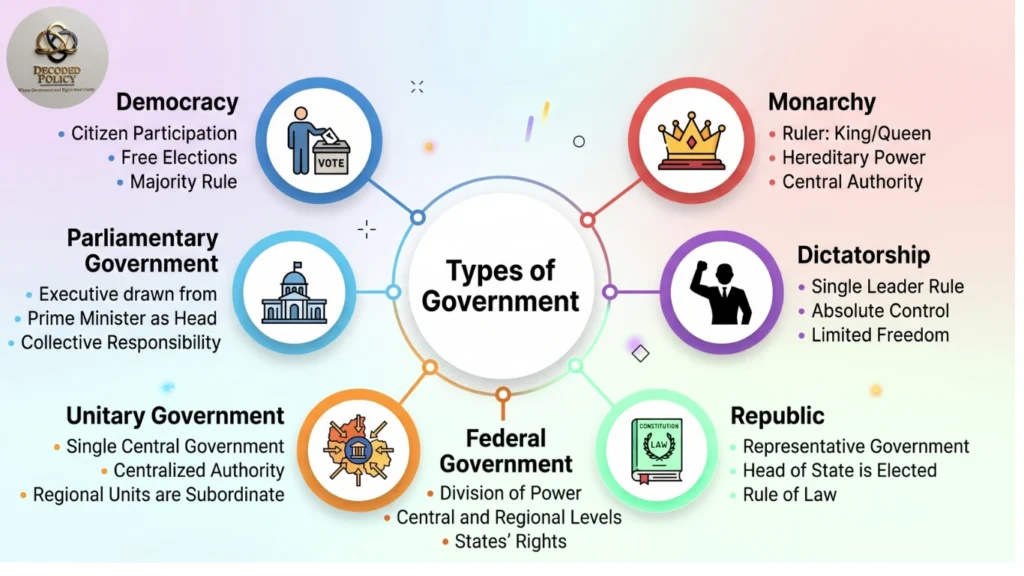
How Different Forms of Government Influence Public Policy
The nature of public policy largely depends on the form of government followed in the country. In simple terms, ‘what is government?’ refers to the system that governs and manages a society, and this system directly influences how policies are made and implemented. In a democracy, policies are usually made through public opinion, elections, and debates, which makes the policies more inclusive but can sometimes be slow.
In a dictatorship, policies are made quickly because decision-making is centralized, but there is less public participation and transparency. In a federal system, policies are made through coordination between the Centre and the states, which makes it possible to address regional needs. Thus, the structure of the government directly shapes policy outcomes.
Role of Government in Promoting Good Governance
The government plays multiple roles to promote good governance, such as policy-making, implementation, and monitoring. An effective government is responsive and timely in addressing the needs of citizens.
Digital governance and e-governance initiatives are making government service delivery fast and transparent. Initiatives such as online portals, digital payments, and grievance redressal systems have helped reduce corruption. Furthermore, decentralization empowers local governments, allowing decision-making to reach the grassroots level.
Hidden Challenges and Limitations of Government Systems
Government systems face several challenges that directly affect governance:
- Bureaucratic Inefficiency (Red Tapism)- Complex procedures and paperwork slow down decision-making and delay policy implementation.
- Corruption and Misuse of Power- Misuse of public resources and bribery undermine governance and damage public trust.
- Lack of Transparency and Accountability- Decisions are often unclear or in the public interest, creating a trust deficit.
- Political Interference- Policies are sometimes made for political gain rather than public welfare, which affects the quality of governance.
- Slow Decision-Making in Democracies- The inclusive process makes decisions take time to reach, which can create problems in urgent situations.
- Center-State Conflicts (Federal Systems)- Conflicts can arise due to the division of powers within a federal structure, affecting policy implementation.
- Over-Centralization (Unitary Systems)- The central government’s excessive power can lead to local needs being overlooked.
- Economic and Resource Constraints- Limited resources and budget constraints prevent all policies from being effectively implemented.
- Crisis Management Challenges- It becomes difficult to provide timely and effective responses to pandemics, natural disasters, or global conflicts.
- Technological and Digital Divide- Even in the era of digital governance, not everyone has equal access to technology, which can increase inequality.
Conclusion: Government as the Foundation of Governance and Public Policy
This discussion makes it clear that the government is not just a ruling authority, but the backbone of governance and public policy. Whether it is a democracy or a federal system, each form has its own impact on policy-making and implementation.
Also, challenges such as corruption, inefficiency, and policy delays need to be addressed for governance to become effective.
In today’s digital age, a government will have to adopt a citizen-centric approach where the focus is on transparency and participation. This understanding of ‘what is government?’ highlights its evolving role in modern society. Thus, the government will remain a central pillar of governance in the future as well.